Tag Archives: wellness

Training to Become a Regular Exerciser

RegExVideoStill

It’s 2014 and it’s time for a new FREE video.  YAY!

In this video (click above) I offer some new tools to help make 2014 the year YOU become a regular exerciser.  Learn how to use your fun inventory to find your exercise bliss, use exercise “speed dating” to try before you buy and participate in my “Rock the Block” (TM) exercise to help you find your appropriate fitness starting point.

Plus learn more about my 12-Week Every BODY Can Exercise  program, designed to help make your exercise program social, successful and super fun!

Happy New Year,

Jeanette DePatie, AKA The Fat Chick.

What are the odds?

Hey there!  Sorry I haven’t blogged in a few days.  I’ve been on the roller coaster and hanging on for dear life.  Seems like that’s the way of it, doesn’t it?  First you’re on top of the world, and then BOOM, sick in bed with a terrible, nasty, icky head cold.

It’s not like I haven’t taken prophylactic measures.  I’ve been taking lots of vitamin C, drinking lots of water, washing my hands raw and all of that good stuff.  I’ve been doing my very best to get good sleep and trying my best to manage stress.

Ever since I felt a sniffle, I’ve been rubbing menthol on my feet and sucking a zinc lozenge every few hours and drinking massive quantities of tea.

I’m doing everything that statistics suggest I should to prevent and minimize colds.  So why am I still sick?

I got sick because I got sick. No matter how many steps you take, you can stick get sick at any time.  Does that mean I shouldn’t have taken those steps to try to minimize my risk and minimize my symptoms?  Well no.  The steps didn’t have many potentially negative side effects and weren’t too difficult.  And they might have worked.  And who knows, things might have been worse had I not taken those steps.

But this is the thing about statistics and health.  If there’s a 1% chance of getting sick, that means that out of every 100 people, about 1 will get sick.  And no matter how many remedies you try, no matter how strong your immune system may be, that one person might be you.  And as tempting as it might be to believe you didn’t get sick because of the mouthwash you used, or the special ritual you followed, you might not have gotten sick because of dumb luck.

So as much as we may wish to believe that we are “healthy” because we are virtuous people who eat whole grain cereal and do yoga, I think we need to give at least a passing nod to all the other stuff that goes into it.  As Fall Ferguson writes in her post on the ASDAH blog: there are many, many factors that go into whether or not a person is healthy.  Doing healthy stuff is just one of those things.  So where does this leave us?

We may wish to do stuff that increases our odds of being healthy.  How much stuff we are able to do may well be decided by our socioeconomic status or access to good healthcare.  How effective those healthy behaviors are may well be decided by our genetic makeup.  How much stuff we choose to do is up to each and every one of us.  It’s time we give up the notion that being healthy is “virtuous” and being sick is a sign that we are “weak, lazy, undisciplined or unconcerned”.  Sometimes we just got sneezed on by the wrong person at the wrong time.  There are no guarantees.

So even though I feel tired, and cranky and stuffed up and sneezy and sick, I choose not to bother feeling guilty.

Love,

The Fat Chick

P.S. Still waiting to hear when our Katie Couric episode will air.  Will keep you posted!  oxoxoxoxox


Why BMI stands for “Blatantly Meaningless Information”

Yup, higher shoe size means higher BMI. Maybe we should re-institute foot binding for better health?

The LA Times has published another awesome article, this time taking aim at BMI.  The article headline states “For nearly 1 in 5 Americans, BMI may tell the wrong story”.  Although one of the main studies actually places the misdiagnosis statistic closer to 2 in 5 Americans, I have to give the LA Times credit for posting this story which goes on to detail something that many of us in the HAES (R) universe already know: BMI is not a good predictor of individual health.  In short:

Having a high BMI does not mean you have poor metabolic health.  Having a low BMI does not mean you have good metabolic health.

So why is this important?  Well for a lot of reasons.  First off, if your doctor is using BMI to determine whether or not you should get further screenings or tests, he or she is using an extremely unreliable metric to make this determination.  This means as a fat person you may be exposed to a lot of tests you really don’t need.  This means as a thin person, your doctor may miss some stuff that is really important or even life-threatening.  I often wonder if a significant proportion of the medical costs associated with fat people are because we have so many more tests done.  Or even if higher percentages of certain diagnoses among fat people are in part because we look so much harder for these diagnoses among fat people.

Another reason that BMI bias is such a big problem is that the workplace wellness gurus are using it to coerce or even force us into interventions that may be entirely inappropriate for us.  For example, I’ve been talking a lot about this Michigan “walking program” for fatties.  BMI was used as the sole determinant as to who had to participate.  Those with higher BMIs were told they either had to wear a pedometer that reported their steps to the “home office” or they had to go to Weight Watchers.  There was no initial fitness assessment done.  There was no assessment of eating behaviors.  The program simply assumes that people with higher BMIs don’t engage in fitness and eat very poorly.  It’s entirely possible that people in the program had to reduce other, more strenuous and more enjoyable exercise programs in order to comply with the stupid walking rules.  It’s entirely possible that people in the program with well-balanced healthy eating habits were encouraged towards more disordered eating habits after their new stint with Weight Watchers.  It’s almost certain that people with low BMIs who are also sedentary and eat nothing but junk food were patted on the head and told to “keep up the good work”.

But we’ll never know because they never tested this stuff.

You know what?  When company money and government money and my money gets spent on stupid health programs that are just as likely to make people less healthy than before, and nobody bothers to test the hypotheses because “fatties” I get pretty annoyed.  In fact I’m crossing right over the line towards enraged.

It’s not like this research is all new.  It’s not like the problems inherent in the BMI as a measurement of individual health haven’t been known for decades.  But as long as entire industries are set on putting their fingers in their ears and chanting, “La, la, la, I can’t HEAR you!” I’m just gonna have to keep on saying the same things over and over and over.  As long as people walk around with misdiagnosed brain injuries because doctors simply think they need to lose weight, as long as thin people miss out on important medical screenings because they are assumed well, and as long as some insurance programs think it’s okay to strap a piece of hardware to my a@@ to track whether I’m moving enough just because of my dress size, I’m gonna keep on talking.

You hear that universe?  I’ll keep shaking my chubby fist and you and shouting that your BS. Measuring. Instrument. is not a valid way to understand anything about who I am.

Love,

The Fat Chick


Like my posts?  You’ll love my stuff!

Buy my book: The Fat Chick Works Out! (Fitness that is Fun and Feasible for Folks of All Ages, Shapes Sizes and Abilities)–available in softcover and e-book versions

Buy my DVD: The Fat Chick Works Out! (A Safe, Easy and Fun Workout for Klutzes, Wimps and Absolute Beginners!)

Buy a book or a DVD for a friend and save $5!  Just enter FRIENDBLFT in the discount code box!

Check out my Training Programs–both in person and via Skype (Starting at just $25!)

or

Book me to speak at your special event!
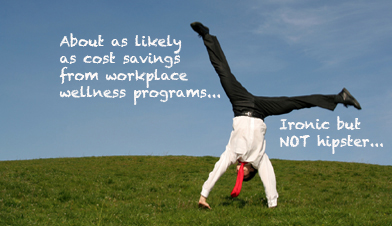
Workplace Wellness Doesn’t Heal the Bottom Line

workplace_wellness copyI think we’ve seen lots and lots of press of late concerning workplace wellness.  There are a variety of companies charging huge premiums to corporations promising companies healthier employees.  And each of these companies, in turn, promises a healthier balance sheet by reducing worker healthcare costs.  A lot of c-level employees have spent a fair amount of company cash on these promises.  So it’s probably not surprising that when Rand Corporation issued its recent report concerning the effectiveness of workplace wellness programs there was a scramble.

Rand Corporation briefly posted the government-mandated report on its site last Friday.  Very shortly after it was posted, it was withdrawn.  The following statement was posted in its stead:

“This document was posted in error and has been withdrawn pending completion of contractual obligations to the project sponsor.”

Before the document was pulled, Forbes magazine managed to snag a copy.  Forbes didn’t waste any time posting an article about the findings of the report.  I’ll summarize the report for you here.

Most workplace wellness programs don’t work.

Yup, you heard it.  It seems that most of the millions and even billions of dollars of corporate cash being dumped into workplace wellness programs that don’t offer any statistically significant benefit.  In short:

1.  Most workplace wellness programs don’t lead to better health among employees.

2.  Most workplace wellness programs don’t lead to statistically significant weight loss in employees.  On average attendees of the wellness programs lost 1 pound per year for three years.  Even those few programs that showed larger weight loss numbers,  were not able to sustain the benefits.

3.  Most workplace wellness programs don’t lead to better behavior.  Even smoking cessation programs generally led only to “short term” improvements.

4.  Most workplace wellness programs don’t lead to better health markers.  There were no statistically significant improvements in blood pressure, cholesterol, or blood sugar.

5.  Most workplace wellness programs were unable to demonstrate lower costs for hospital or emergency care.

The bottom line is that, as a whole, the workplace wellness programs cost the companies money and did not create statistically significant cost savings.  In fact, on average, cost savings averaged $2.38/month for year one and $3.46/month for year three.

Not long after Forbes published its article, it seems that the cat was well and truly out of the bag.  And the Rand Corporation published the report.  You can see the full PDF here.

All of this is especially relevant to us fat folk.  For the past few days, I have been at the ASDAH Conference.  I’ve been leading fitness classes, speaking about Health At Every Size(R) and hearing a LOT about how workplace wellness programs disproportionally affect people of size.

The fact is, that a lot of workers who don’t have a “government-sanctioned” BMI or waist circumference are required to choose between paying higher premiums and enrolling in company “workplace wellness” programs.  Many of these programs violate worker privacy and shame workers in front of co-workers.  Imagine if you are required to go to a workplace-sponsored “Weight Watchers” program and are required to step on a scale in the same room with your boss or your co-workers.  Just think about the trauma this could cause.  Then think about that trauma in light of the fact that these programs simply don’t work.  The programs don’t help you lose weight in the long run.  These programs don’t help you be healthier.  And these programs don’t even save the company money.  It’s a lot of personal drama and trauma that provides absolutely no benefit to anyone outside of the company selling the workplace wellness program and Weight Watchers.

It doesn’t benefit the companies.  Which isn’t a super big surprise, given the fact that many c-level employees fail to scrutinize or even understand these programs before they are implemented.  According to the RAND report, only 44% of companies who used wellness programs have ever evaluated them and only 2% have “detailed information” about how much the company has saved as a result.  Uh-oh.  There goes that boat you were gonna buy with your annual bonus.

It doesn’t benefit employees.  Many employees resent being asked to show up at potentially embarrassing, and decidedly time-consuming programs that don’t work.  They don’t like it and it doesn’t improve their health.  Um, check please!

As advocates of Health At Every Size, this is a space that will be worth watching.  In the meantime, I offer this health advice absolutely free:

1.  Manage your stress.

2.  Get good quality and quantity sleep.

3.  Move around in a way that feels good and joyful to you.

4.  Eat a wide variety of foods that taste good to you, and take time to savor and enjoy them.

5.  Connect often with people you love and people who love you.

All that stuff is scientifically proven to improve your chances at good health.  And you didn’t have to take time off work, step on a scale or tell your boss your intimate health details to get that information.  You’re welcome.

Love,

The Fat Chick

Like my posts?  You’ll love my stuff!

Buy my book: The Fat Chick Works Out! (Fitness that is Fun and Feasible for Folks of All Ages, Shapes Sizes and Abilities)–available in softcover and e-book versions

Buy my DVD: The Fat Chick Works Out! (A Safe, Easy and Fun Workout for Klutzes, Wimps and Absolute Beginners!)

Buy a book or a DVD for a friend and save $5!  Just enter FRIENDBLFT in the discount code box!

Check out my Training Programs–both in person and via Skype (Starting at just $25!)

or

Book me to speak at your special event!

Your Big Fat ASSumptions: The Right Now Show Episode 014

donkeys-who-assume

Today’s episode of the Right Now Show shares two things that you may safely assume when looking at a fat person.  We also discuss five Big Fat ASSumptions that we routinely make about people of size and whether or not those assumptions have any validity.  Enjoy watching, and don’t forget to share with all your friends:

Here’s some additional information and resources you may want to consult after watching the show:

Want to join a whole lot of other people enjoying exercise in an environment which is free of fat shaming at weight loss talk?  Check out the Fit Fatties Forum!

Want to stay up to date on the very latest info about fat and health?  Join the Fat Chick Clique.  It’s free!

Here’s a link to a lot of the most recent research about Fat and Health on my website.

Here’s some more information about fat and shame on my blog:

Here’s a comprehensive review about fat and health which reviews over 100 other major studies about fitness, fatness and health:

Here’s some information offered by the Association for Size Diversity And Health about Health At Every Size (R):

P.S. Like my posts?  You’ll love my stuff!

Buy my book: The Fat Chick Works Out! (Fitness that is Fun and Feasible for Folks of All Ages, Shapes Sizes and Abilities)–available in softcover and e-book versions

Buy my DVD: The Fat Chick Works Out! (A Safe, Easy and Fun Workout for Klutzes, Wimps and Absolute Beginners!)

Buy a book or a DVD for a friend and save $5!  Just enter FRIENDBLFT in the discount code box!

Check out my Training Programs–both in person and via Skype (Starting at just $25!)

or

Book me to speak at your special event!

Right Now Show Episode 010: Craving the 2K Cookie

Many of us have been taught that cravings are something to be thwarted, ignored or denied.  But our bodies have a way of insisting on getting what they want.  In this video you will learn about why it’s so important to pay attention to cravings, what happens when you ignore cravings and the very simplest and most effective way to deal with cravings.  You’ll also learn about the 2,000 calorie cookie, so check it out!

Intuitive eating can be extremely challenging.  But there is help out there.  Here are a few important resources:

The Fat Nutritionist

Ellyn Satter (especially in the area of family nutrition)

HAES(R) research about eating

And the amazing Golda Portetsky

Hope you get a chance to be good to yourself and treat your body well, right now!

Love,

The Fat Chick

Fit Fatties Across America–California, Baby!

Well hello out there.  I’m so very proud to announce we have reached my home state, California in the Fit Fatties Across America project founded by myself and the amazing Ragen Chastain!  We’ve walked, shimmied, swum, cycled and boogied across this great country of ours for a total of over 2,500 miles!  And it’s only just March.  It’s just so darn exciting to see what we can do together.

I’m especially excited about the way that we are busting stereotypes with this cool project.  Many people hold the prejudice that if fat people never exercise.  They think we just sit on the sofa all day eating bon bons.  (What the heck IS a bon bon anyway?)  But our mighty group of plus-sized exercisers have racked up over 2,500 miles in just over eight weeks. It’s a testament to the power of the Health At Every Size approach to wellness, and it’s super fun!

Aside from the Fit Fatties Across America project, the Fit Fatties Forum is a great way to be inspired by exercisers of ALL sizes.  Our forum currently boasts over 1,500 members as well as over 350 fabulous photos of fat people dancing, swimming, cycling, shimmying, lifting very heavy things, aiming arrows, and flashing some flaming hula hoops!  The pictures are amazing.  What a fabulous, myth busting, stigma shattering resource for men and women of all sizes!

Now, my loyal readers, I’d like to enlist your help.  Some of us local California peeps are planning to meet at the beach to do the final leg of the Fit Fatties Across America project together on Saturday, March 19.  But that means that as a group, we need to clock just over 200 miles in the next two weeks.  Will you help us get there?  If you’re not already a member of the Fit Fatties Forum, would you consider joining?  It’s totally FREE!  And if you’re already a member of the Fit Fatties Forum, would you consider entering your exercise totals for the next two weeks so we can reach our goal?  And if you are a member of the Fit Fatties who lives in the LA area, would you consider joining us on March 19 to finish the last few miles of this great project together live, and in person?  Let’s dip our toes in the big blue ocean together!  Let’s show ’em just what a few fatties can do!

Love,

The Fat Chick


What Happens When We “Let Ourselves Go”…

TheFatChick

After I tell people that I support Health At Every Size (R) and after I explain what Health At Every Size is, people often share with me their fear that if they ever stopped strictly policing their body size, their food intake and their calories burned, they will grow “big as a house” and they will “never stop eating”.  Now this fear is natural.  We’ve been conditioned to believe that we are just one chocolate chip cookie away from total body apocalypse and that only constant, fierce and consistent vigilance will keep us from serious medical harm.  There’s a $60 billion dollar diet industry as well as an unbelievably huge system of bariatric surgery and drugs and research grants and public health initiatives to support the notion that if we take our eyes off the thin body prize for even a moment, all hell will break loose.

Except, in my experience, it kind of doesn’t.

Some recent research coming out of Australia, seems to support the notion that Health At Every Size and Size Acceptance does NOT generally lead to giving up on health altogether.  “The Role of the Fatosphere in Fat Adults’ Responses to Obesity Stigma: A Model of Empowerment Without a Focus on Weight Loss” details interviews with 44 bloggers in the “Fatosphere”.  The subjects of these interviews often talked about moving from a reactive response to stigma (attempting weight loss to conform to societal norms) towards a proactive approach to stigma (recognizing stigma, reframing fat, and focus on self-acceptance).  These bloggers described significant improvements in well being as a result of being associated with the size acceptance community and taking a direct approach to dealing with shame and stigma.

Granted, we’re only talking about 44 bloggers here.  This is hardly a representative sample of fat people all over the world. But it does seem to map to my experience.  For a short time after I declared all foods legal and nothing off limits I ate a LOT of cookies and chips and pizza.  But after not very long, the bloom was off the rose.  I found I really didn’t want another candy bar.  I wanted broccoli.  I wanted chicken.  I wanted whole wheat bread and peanut butter.  I wanted real food.  Once the “forbidden” label was removed from foods, I found I could often take them or leave them.  I could eat one cookie.  I could eat 3 potato chips.  Because you know what?  I knew I could have them again whenever I wanted them.

Once I removed the notion of punishment from my physical activities and started focusing on finding exercise that was fun, I started enjoying my workouts a whole lot more.  Rather than dragging myself up onto the treadmill and burning an arbitrary number of calories, I called the dog and we went outside for walkies.  I got my heart pumping.  I bumped up my Vitamin D levels.  And I HAD FUN.  When I accepted that I no longer had to do exercise that I hated, I found myself free to focus on fitness that I loved.  I learned to look forward to workouts again.

Clearly I’m citing anecdotal evidence here.  But there is plenty of other research by amazing people like Linda Bacon and Lucy Aphramor that explains what happens when people lose their obsession with weight loss and start focusing on the Health At Every Size approach to wellness.  What happens is that folks get happier and generally healthier all without the nasty side effects of disordered eating, weight cycling and depression so common to the traditional diet-based approach.

So after I tell people about Health At Every Size and after people tell me that they can’t support HAES because they would lose all control and would wind up desperately unhappy and unhealthy, I still have an ace up my sleeve.

I share the overwhelming evidence that the HAES (R) approach typically leaves people at a weight that is natural for them with a body that is healthier and with a mind that is happier than ever before.

Seems like a safe bet to me.

Love,

The Fat Chick


Dealing with Diabetes: Episode 004 of the Right Now Show with Jeanette DePatie (AKA The Fat Chick)

Are you coping with diabetes?  Is your doctor shaming you because of your weight?  Do you wish you had some body-positive advice for coping with this disease?  I’m pleased to share with you episode 004 of The Right Now Show. In this episode, I answer a viewer’s question about dealing with Type 2 diabetes. Tune in for helpful hints for taking a Health At Every Size (R) approach to coping with this challenging disease. I offer tips for integrating exercise (even when coping with chronic pain), managing stress, and how to keep loving the skin you’re in through it all.

There are more tips available about coping with diabetes in a special article I wrote for the Association for Size Diversity And Health available here.

And there’s a really fun music video I did with Ragen Chastain all about managing family boundaries during the holidays available HERE.

You can learn a lot more about The Fat Chick on my website.

And you can buy Jeanette’s progressive workout DVD (with that 10 minute beginning workout) on the shopping page or at Amazon.com HERE.

Thanks so much for watching and don’t forget to subscribe!

Love,
The Fat Chick

Body Intelligence or Body War?

golda_biggest_loser

This week, I’ve come across two very different approaches to young bodies in the media.  One is the announcement (and subsequent activism response by the amazing Golda Poretsky) that the television show “The Biggest Loser” will now include teenagers and the other is a new study about the effectiveness of “intuitive eating” among young adults.

It’s hard to imagine a stronger dichotomy than these two approaches.  On the one hand, we have “The Biggest Loser” which teaches us that our body is the enemy.  No punishment is too harsh.  No humiliation is too great.  We must deprive ourselves of delicious foods.  We must exercise until we vomit or pass out.  We must make our bodies thin at all costs.

The study outlines a different approach (at least to eating) by documenting the outcomes of young adults who practice intuitive eating.  The study defines intuitive eating by the young people “trusting their bodies to tell them what to eat” and “stopping eating once they felt full”.  Based on the Biggest Loser story, one would imagine that those who trust their bodies and allow hunger to guide their eating would be larger than those who focus on controlling body weight.  However, the study seems to indicate the opposite.  Those who trusted their bodies not only had fewer signs of disordered eating, but also had a lower average BMI.

Now, it’s important to remember that this is only one study.  But we’ve yet to unearth a single study that indicates that deprivation and self hatred is an effective way to maintain a lower body weight or BMI over the long term (more than 5 years).  So what should we be teaching our kids, to love their bodies or make war on them?

While it seems obvious to me that teaching kids to trust the innate intelligence of their bodies is the better choice, I think it’s important to recognize this is not the easier choice.  I think peer pressure plays an enormous role both for children and their parents.  I think many of us have faced discrimination and outright cruelty from others because of the size of our bodies.  We don’t wish that pain on our worst enemies.  So it’s not surprising that we don’t want it for our children.  And the prevailing wisdom of the women at the beauty shop, Aunt Thelma and even our pediatricians often involves hushed side conversations about what the parent is going to “do” about a child’s weight.  It seems clear to me that peer pressure bends us towards putting our kids on diets, obsessing over their BMIs, forcing them to exercise, sending them to fat camps and yes, even allowing them to be on “The Biggest Loser”, even though there is so, SO much evidence out there showing that this approach doesn’t work.  But at some point, we have to ask ourselves, “Is peer pressure a smart way to decide what’s best for kids?  Is bowing to peer pressure in this case going to make our kids happier or healthier in the long run?”  I think we need to ask the proverbial question, “If our friends tell us to run off a cliff, will we do it?”  Or will we put peer pressure aside, assure the ladies at the beauty shop and Aunt Thelma and even our pediatrician that we are doing what science indicates is best for our kids, and teach them that their bodies are wondrous and intelligent and trustworthy?

I’d love to hear what you think.

Love,

The Fat Chick