Tag Archives: HAES

The Right Now Show 013: Finding the Right Fitness Trainer


In this episode, Jeanette DePatie AKA The Fat Chick shares some information about finding the right fitness teacher or trainer.  She shares a personal story about a really disastrous bout with a personal trainer and gives you practical tips for finding a personal trainer that is just right for you!

By the way, Jeanette also offers personal training both in person and remotely (via Skype).  You can learn more on her website right here: http://www.thefatchick.com/The_Fat_Chick/Training.html

If you sign up right away, you can try any of my monthly training packages for only $25.  That’s nearly $100 off my most comprehensive plan!  So don’t wait.

Love,

The Fat Chick

Stuff that Weighs More than Me: A Mil V-12 Helicopter

helicopter

Okay, I think it’s safe to say that pretty much any helicopter weighs more than me.  But there are helicopters, my friend, and there are HELICOPTERS.  I mean just look at that thing.  It’s so big that a regular helicopter nestles like a tiny baby upon it’s ginormous wing.  We’re talking HUGE.

The giant flying machine pictured above is actually an Aeroflot Mil V-12 (also known to NATO as a HOMER).  It is the largest helicopter that has ever been built.  It never went into full scale production and only two prototypes were ever built.  The large aircraft was built specifically to carry major missile components and was designed to carry a payload of 30,000 kg. (That’s 66138lb 10.944oz to us English System folks.)

The initial prototype took it’s maiden voyage on July 10, 1968.  It achieved a world record, lifting 44,205 kg to a height of 2,255m (7,398 feet).  Here’s the stats:

Crew: 6

Height: 12.50 m (41 ft 0 in)

Length: 37.00 m (121 ft 4 in)

Loaded weight: 97,000 kg (213,850 lb)

Maximum takeoff weight: 105,000 kg (231,500 lb)

Conclusion: I don’t think you’d need to lift the armrests to ride in this baby, and the Mil V-12 weighs more than me.

Love,

TFC


Just What the #$%&! am I Supposed to Eat!?!

eatmyshorts

So have you seen the article in the New York Times that says it might be okay to eat salt again?  It seems some recent research is calling into question the American Heart Association’s recommendation of 1,500 milligrams a salt per day.  Now on the one hand, this question is almost moot, because it’s nearly impossible to achieve 1,500 milligrams of salt a day and do things like occasionally eat food that has had any processing, eat out once in a while, or you know, live in the modern world.   On the other hand, there are some indications that consuming sodium levels as low as 1,500 milligrams per day might actually be harmful.  So it probably does merit a second look.

So according to the article, several recent studies have indicated that a sodium level goal of 2,300 might be better than 1,500 milligrams per day.  Some of these studies have even indicated that the 1,500 level might actually be dangerous for some people–potentially increasing risk for heart attack and death.  The American Heart Association has fired back suggesting that the more recent research has flaws and that they don’t want to confuse people by giving them the message that a little more salt is okay, because you know, people might then go hog wild and eat lots of salt.

And then, near the end of the article is this little gem:

Although the advice to restrict sodium to 1,500 milligrams a day has been enshrined in dietary guidelines, it never came from research on health outcomes, Dr. Strom said. Instead, it is the lowest sodium consumption can go if a person eats enough food to get sufficient calories and nutrients to live on. As for the 2,300-milligram level, that was the highest sodium levels could go before blood pressure began inching up.

Okay.  So the advice that has been cemented in stone, that is inevitably printed on that bad, multi-generation photocopied piece of paper handed to every fat person in the universe by their doctor when they go in for a check up or to get that funny looking mole checked out is based on what now?  It’s no wonder that we are confused about what to eat.  The competing nutritional studies along with the sensationalist, usually premature reporting is enough to give any potential diner whiplash.  Eat margarine!  No, eat butter!  Eat olive oil.  Eat nuts.  Eat red meat.  Don’t eat red meat.  Eat fish.  But watch out, most of the fish is full of toxins.  Eat dairy.  Don’t eat dairy.  Eat low fat.  Eat low carb.  Eat only plant-based foods.  Plant-based foods are genetically modified and full of pesticides.  OMG.  Eat my shorts!  It’s no wonder that we are going crazy trying to figure out what on earth to have for lunch every day!  Add to that the woeful lack of education among GPs and pediatricians about nutrition and you get the typical photocopied sheet of “black coffee, one piece of wheat toast, and one glass of orange juice” advice.

Now all this is not to say that we shouldn’t be concerned about what we eat.  But it is to say that nutrition is a very complicated science.  And that while we let the scientists duke it out about exactly how many milligrams of this and percentages of that we should consume, maybe we should simply focus on what foods feel good in our bodies and what tastes delicious.  I believe our bodies have wisdom, and that we benefit when we learn to listen to what our bodies have to tell us.  It may be hard to hear our “smarty-pants inner-selves” amongst all the screaming about “vitamin this” and “mineral that”.  But I for one, plan to make the effort.  Oh, and would you please pass the salt?

Love,

The Fat Chick

The Body’s Battle with Weight Loss

slide33.033I recently ran across this little gem on Cracked.com entitled “Fat is Officially Incurable (According to Science)” which offers a surprisingly accurate portrayal about just how likely those “before” and “after” shots in advertisements are to reflect the long-term experience of real, live people.  While proceeding with tongue firmly inserted in cheek, the author offers a nice summary of some of the scientific evidence offered regarding long-term weight loss:

  • Probability of long-term maintenance of very modest weight loss (10-15 pounds)–Very low
  • Probability of a fat person becoming (and staying) a thin person–Practically Non-existant.

One of my favorite things about this article (besides David Wong’s deliciously snarky attitude) is the plethora of links to some other wonderful content that I’ve read, but probably forgotten about.

For example, a lot of the math about Weight Watchers “success stories” (including why you may be 20 times more likely to survive being shot in the head than you are to reach and maintain your WW “goal weight”) is derived from this wonderful blog post by fat fu.

And David also references this comprehensive NY Times Article in which Tara Parker-Pope breaks down a lot of the recent research about why permanent weight loss can be so difficult.  She talks about a lot of the physiological changes that can happen with weight loss including:

  • Increased hunger hormones like ghrelin that make us feel more hungry.
  • Decreased leptin and peptide yy in the body which help to signal when our bodies are full.
  • Lowered metabolism.
  • Increased percentages of slow-twitch muscle fibers that make our bodies use calories more efficiently and burn fewer calories during physical activities.
  • Increased “reward response” to food in the brain leading to more intense cravings for and obsession about food.

Tara also reminds us that these changes in the body are often long-term–lasting months or even years after the dieting has stopped.  And while both she and David Wong admit that there are some “rare creatures” found in the National Weight Control Registry who have maintained significant weight loss, the vast majority of us are unlikely to experience the same results.

I don’t say this to depress you.  But I do feel very strongly that those of us who work in the health and fitness industries have a responsibility to help our clients to build realistic expectations.  Very, very few of us will lose a lot of weight and keep it off.  A very slightly larger number of us will lose a little bit of weight and keep it off.  But most of us will neither lose a significant amount of weight nor will we keep it off. Does that mean we need to give up on either wellness or well-being?  Nope!  As it turns out, bodies respond very well to healthy behaviors regardless of whether or not they are accompanied by any weight loss.  We can choose to de-couple wellness from weight loss and focus on simply doing the things that make us feel well.  So in my mind, it really makes more sense to take this Health At Every Size(R) or HAES approach and let the body’s weight settle where it will.

And even though telling the truth has seriously blunted my book sales and ruined my chances of ever starring in my own late-night, cheesy infomercial, I still must tell it.  Oh well, I’m more of a morning person anyway.

Love,

The Fat Chick


Only Fat People Need to Walk: As Indicated by Blue Cross Program

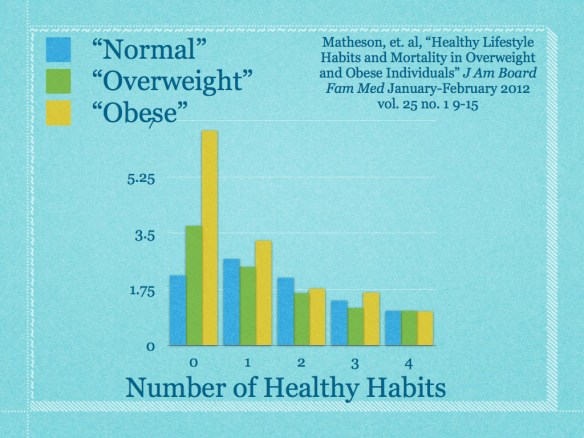
Study showing healthy habits most important for health outcomes.

Study showing healthy habits most important for health outcomes in ALL weight categories.

Oh dear.  I think it’s going to be hard to keep up with all of the discriminatory practices being rolled out by insurance companies to punish those who are fat.  But this new announcement from Blue Cross Network is really above and beyond.

Blue Cross recently announced that its program, offering cash discounts to obese members who agreed to add 5,000 steps a day and be measured via a pedometer was a “success”.  Discounts were significant–representing a cost savings of up to $2,000 per year per family.  Apparently these “discounts” were not offered to anybody who was not obese.  But Blue Cross is claiming success, due to the fact that most of those who enrolled in the program were still walking one year later.

I particularly love the fact that despite the fact that Blue Cross of Minnesota cites this press release as its source, the headline for their online blurb reads, “Money Motivates Weight Loss, One Step at a Time”.  I went back to the original press release.  I read it twice. Not one word is said in that press release about weight loss.  NOT ONE SINGLE WORD.  Holy “make it up as you go” reporting, Batman!  It is possible that there is some mention of the press release in the study announcing the findings.  But there is absolutely no mention of weight loss in the abstract.  And in my experience, were weight loss found in the study, it would be in the title of the study and the first sentence of the abstract.  If anybody has access to the full study, I’d love to know if this holds true.  But in any case, the piece on the Blue Cross webpage did not cite the study but rather the press release as its source.

Now, all of this leaves me with a few key questions.  First and foremost, is walking only beneficial to fat people?  Why in the world are they only offering this incentive to people qualified as “obese”?  There are so many studies that show that modest exercise is beneficial to everybody’s health.  And there’s plenty of evidence showing that healthy habits and not weight loss is what is needed to improve health outcomes?  So why are only fat people singled out for this treatment?  And are these actually “discounts” or are we really talking about being rescued from “fat penalties” not being faced by other insurance network members?

It’s also interesting to note that obese members were allowed to choose between this walking program (created by online biometric site, Walking Spree) or Weight Watchers.  Look, I would clearly pick a walking program over Weight Watchers any day of the week, but I wonder if these “obese persons” were interviewed to see if they had been exercising before this incentive was offered.  Were these people actually sedentary?  What about fit fatties like me who already exercise nearly every day?  Were we offered the same price increases/incentives?  Would I be expected to add this onto my already active exercise program?  Do I have to exercise three times as much as a thin person in order for my exercise incentives to “count” and my discounts to kick in?

I also find it extremely instructive that the first line of the press release reads as follows:

It was a controversial move when a health insurer began requiring people who were obese to literally pay the price of not doing anything about their weight – but it worked, a new study finds.

Okay.  First let’s look at the “not doing anything about their weight” line.  How do we know they weren’t doing anything about their weight?  We know that diet and weight loss attempts fail most of the time in the long term.  Some suggest they fail over 90 percent of the time.  So by “not doing anything about their weight” do we mean that people refused to engage in the dangerous practice of weight cycling? Do we know that people weren’t eating well or exercising before and that they are doing those things now?  Do we know that they were sedentary before and are now active?  Or were some of these people active before and have simply shifted to a less rigorous form of exercise (walking) than before in order to receive a discount on their health insurance?

It’s also interesting to note how the release defines “success”.  Again, nowhere in the release does it state that people lost weight.  Nowhere in the release does it state that there were positive health outcomes or lower healthcare costs.  In fact the final line of the release states:

“Comprehensive evaluations are needed to determine whether participation in these programs translates to meaningful changes in health and costs of health care.”

Overall, I have to state that this press release, issued by the University of Michigan Health System is astonishingly devoid of detail, definition or real facts.  While positively gleeful about the fact that most of the people who elected to participate in this program remained participants for over a year, it really leaves us with more questions than answers.  Did people who didn’t like the coercive nature of the program leave the network for a different insurer?  What were the changes in attitude towards exercise among participants?  Did they grow to like exercise more or see it as a punishment?  What are the long term effects on attitudes towards exercise?  And finally, why are we singling out fat people for this program?  Don’t thin people need to exercise too?

Aaaaaargh!

I guess I’m pretty worked up here.  Maybe I’d better go for a walk to blow off some steam.  Because some of us fat people go for walks even without “finger-wagging”, “pedometer-wielding”, “biometric-tracking” moralists telling us to do so.

Love,

The Fat Chick

P.S. If you’re looking for a form of exercise that doesn’t come with doom and gloom weight loss messages or any finger wagging whatsoever, you might enjoy buying a copy of my DVD.  And if you are a member of the Fit Fatties Forum, you’ll receive a special discount.  Just click here to order and type FFBL in the discount code box!

Right Now Show Episode 012–Fit-lanthropy: Making the World Better for EveryBODY!

In this episode of the Right Now Show, we talk about “fit-lanthropy”–my term for combining fitness with raising money or otherwise helping other people.  I also unveil a brand new video highlighting some of the fit-lanthropy programs available.

As promised, here’s some more links to get you started.

To get $5 off my book, “The Fat Chick Works Out!” simply follow this link, and enter “fit-lanthropy” in the discount code box.

To learn about how to join the Hot Flash Mobs for Menopause Awareness Month, follow this link.

And here are some great charity fitness training programs:

Joints in Motion (The Arthritis Foundation)

Team in Training The Leukemia & Lymphoma Society (LLS)

Relay for Life (The American Cancer Society)

The Avon Walk for Breast Cancer

Fight for Air Walk (The American Lung Association)

Step Out Walk to Stop Diabetes (The American Diabetes Association)

Tour de Cure (The American Diabetes Association)

Out of the Darkness Walks to Prevent Suicide (American Foundation for Suicide Prevention)

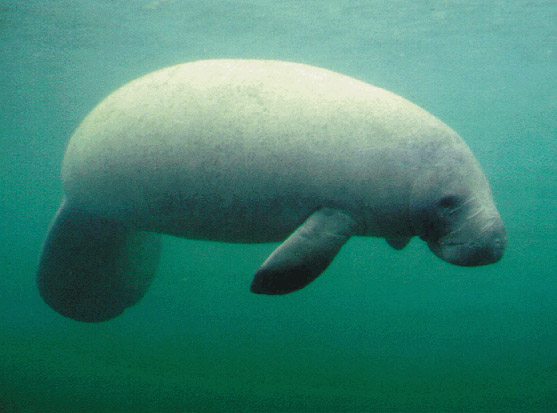
Stuff That Weighs More than Me: The Humble Manatee

manatee

Frankly, I’m a little surprised that I haven’t done this blog post yet.  After all, when the meany, meany, MacMeanersons start taunting the fat folks, this name is definitely in the top ten.  Nevertheless, I’ve never done a post about the awesome and  most wonderful manatee.

The manatee (also known as the sea cow) comprises three of the four living species in the order Sirenia.  The fourth species is the dugong (which can be distinguished from the manatee by its longer snout and fluked tail.)  This vegetarian mammal is born big, typically weighing over 60 pounds at birth!  Manatees spend half their time sleeping in the water, typically surfacing for air once every 20 minutes or so.  They have a number of other unique features including:

  • Teeth that are replaced continually throughout the life of the creature.  Typically there are no more than six teeth its mouth at any given time.
  • A vascularized cornea
  • Eyelids that close in a circular manner
  • A simple stomach with a particularly large cecum (similar to that of a horse).  The manatee’s intestines are very large for their size, typically measuring over 45 meters.

Of course one of the primary features of the manatee is its size.  Here’s the stats:

Length: Averaging 9.2 to 9.8 ft. in length, the manatee can measure as much as 12 ft.

Mass: 880 to 1,200 pounds.

Conclusion, the massive and magnificent manatee weighs more than me.

Talking about Bullying

Image

This past Saturday, I  had the great privilege to speak on behalf of the Size Diversity Task Force at the Stop The Pain Anti Bullying Conference in Riverside.  I spoke about all bodies being good bodies and I talked with them about the fact that weight-related bullying can come from many sources including parents, teachers, doctors and coaches.  It seemed like many of them were interested in the topic and I had a great time.  But one of the moments that really touched me, came from a Dad in the back of the room.

The room was overfilled and he had stood against the wall for the entire presentation.  At the end I asked for questions and he raised his hand.  He said that he had come to the presentation on behalf of his sixteen year old daughter.  He said that he came with his beautiful wife (and he gestured towards her) because he wanted to know how to help his daughter.  He said that his daughter had always been somewhat heavier, and that she was having a hard time accepting herself.  He said that he and his wife told her that she was beautiful every day, but that she was having a hard time believing it.  He wanted to know what he should do.

I told him first of all, that he should keep telling her that she is beautiful.  That maybe it doesn’t seem like it’s sinking in, but that she’s hearing it.  I told her that sometimes we aren’t ready for that message at that moment in our lives, but that there will come a moment at some time in our lives when we are ready, and we will gather those words and those memories to us at that time and we will treasure them always.  I told him that he could offer help, but that he has to be patient.  She will only accept help when she’s ready.  I suggested that he could direct her towards support groups like the Size Diversity Task Force that could some day help her find her way through the prejudice out there and help her emerge triumphant as a size positive freedom fighter.  And I thanked him for asking the question.

Honestly, I was blown away by this guy and his wife.  They cared enough about their daughter to stand in a hot classroom for an hour and listen to me talk about my journey, size diversity, size prejudice, the near impossibility of permanent weight loss, Health At Every Size and more.  They were able to keep their minds open and see if they could learn something new.  And they were humble enough to ask for help.  Now I have no idea what it is really like for them in their house and in their family.  But I was deeply moved by the idea that there are parents out there willing to buck the status quo to really help their kids and there is hope in this world of size oppression within strong families willing to care for their kids in a way that may not be “socially acceptable” but in a way that works.

I am deeply grateful to Kandee Lewis and the Size Diversity Task Force for this opportunity to speak, but more importantly to listen and learn from other folks who are working to end bullying in their own lives and the lives of others.

Love,

The Fat Chick

Stuff that Weighs More than Me: The World Peace Bell

BellIn the aftermath of all our country has experienced in the past week, I felt that I was ready to think about peace.  So today, I bring you the World Peace Bell.  It is located in Newport, Kentucky and is one of more than twenty large peace bells located throughout the world.  It was first rung at the stroke of midnight on January 1, 2000, and it was said that it could be heard up to 25 miles away.

The bell was first cast at a propeller factory in France.  It then underwent a 1.5 month sea journey, and arrived in port at New Orleans, Louisiana.  The bell was then transported to Newport via the Mississippi and Ohio rivers, stopping at 14 cities along the way.  Presently the bell is rung on special occasions and every day at 11:55 AM (so as not to conflict with the courthouse bell which rings precisely at noon.)

Here’s the stats:

Materials: 80% copper, 20% tin

Diameter: 12 feet

Musical Pitch: A

Yoke: 16,512 pounds (7,490 kg)

Clapper: 6,878 pounds (3,120 kg)

Total Weight: 73,381 lb (33,285 kg)

The inscription reads:

“The World Peace Bell is a Symbol of Freedom and Peace. Honoring Our Past, Celebrating Our Present and Inspiring Our Future”.

The bell stands as a symbol for much that I am yearning for this week, and incidentally, weighs more than me.

Love,

The Fat Chick

P.S. If you’d like to learn more about making peace with your body, you might wish to consider buying one of my books or a DVD.  And if you go to my website and buy a copy for a friend, you can save $5 off the regular price! Just click HERE and enter the code “peace4_18” in the box!

For the 100th Time, Shaming People Doesn’t Help!

chalkboard.001This week I ran across even more research that indicates that shaming fat people does not turn them into thin people.  This is hardly the first time this sort of research has surfaced.  I’ve talked about this many, many, many times.  But somehow, it seems nearly impossible to get public policy people and health people to get it through their heads.  They still advocate BMI report cards and singling kids out for special “health interventions” and still do not think they need to add “body size” to any of their legislation about bullying.  And meanwhile, bullying against fat kids is getting worse.

Maybe we should make them all stay after class and write 100 times on the blackboard, “Shaming people does not make them happy, healthy or thin.”  It doesn’t save our country money.  It doesn’t save our children.  Shaming people about their weight does not do anything positive at all.  Shaming or bullying people about their weight:

  1. Makes them more likely to engage in unhealthy behavior.
  2. Makes them less likely to seek medical help.
  3. Makes them miss more school and get lower grades.
  4. Makes them sicker.
  5. Makes them heavier and puts them at greater risk for eating disorders.

Despite a mountain of evidence that dieting and shaming don’t work, and a mountain of evidence that dieting and shaming cause harm, we still have public policy and health experts suggesting that we help kids by shaming them and teaching them to diet.  I think we just might have to give them all a piece of chalk and make them stay after school.

Love,

The Fat Chick

P.S. Want to learn about a body positive approach to health and wellness?  How about checking out my book or my DVD?