Author Archives: fatchicksings

Exercise, Fattie! (But Don’t Make Me Watch)

Warning: Fit Fatty Crossing!

It is one of the great hypocrisies of the fat hating concern troll.  They tell us to put down the cheeseburger, and go for a walk.  They tell us to get off our fat butts.  They tell us to exercise, but just not where they have to see us.

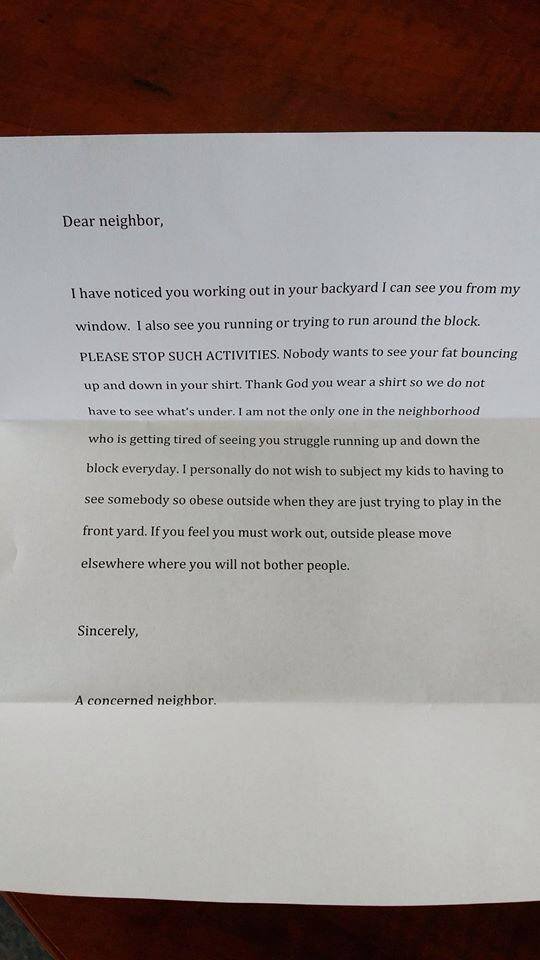
Honestly this whole issue makes me more than a little stabby.  We don’t exercise because concern trolls tell us to.  Because, let’s be clear about this, concern trolls probably don’t have our best interests at heart.  But we do exercise.  Lots of us at all sizes exercise.  We put on our shorts, and we go outside.  We go to the gym.  We exercise because it’s fun.  We exercise because it feels good and then, we get an anonymous letter like the following piece of garbage (trigger warning–extreme asshattery):
10462950_673398942749350_6519269877717548529_n

The letter says:

Dear Neighbor,

I have noticed you working out in your backyard I can see you from my window.  I also see you running or trying to run around the block.  PLEASE STOP SUCH ACTIVITIES. Nobody wants to see your fat bouncing up and down in your shirt.  Thank God you wear a shirt so we do not have to see what’s under.  I am not the only one in the neighborhood who is getting tired of seeing you struggle running up and down the block everyday.  I personally do not wish to subject my kids to having to see somebody so obese outside when they are just trying to play in the front yard.  If you feel you must work out, outside please move elsewhere where you will not bother people.

Sincerely,

A concerned neighbor.

Seriously folks, I barely know where to start with this thing.  Well, let’s start at the top, shall we?  1.  There is nothing dear about this neighbor.  That gentle opening line is in such ridiculous opposition to the rest of this hatefest, that we will just ignore it okay?

2.  Why in heaven’s name is Snooping Sally watching this poor guy work out in his back yard?  It’s his back yard?  It’s his personal space.  Don’t like what you see in the neighbor’s back yard, don’t look!  There, problem solved.  Oh, wait.  There’s more?

3.  Your copious use of run on sentences and complete lack of commas makes me believe you are typing without breathing.  Please calm the heck down.  It’s a fat guy running, not a national emergency.

4.  “Running or trying to run”: ahhhh I see what you did there.  Nope, not even remotely funny.  Let’s move along.

5.  PLEASE STOP SUCH ACTIVITIES.  The writer doesn’t like it.  And clearly, the fact that she doesn’t like it trumps your freedom to do anything.

6.  “Nobody wants to see…” Our letter writer knows this because she is a little bit psychic.  I bet you didn’t know that was going on in your neighborhood.  Here you are, going for a jog and minding your own business, and you’ve got neighbors experimenting with the occult.

7.  “I am not the only one in this neighborhood…”  There is also the writer’s good friend who meets to share malicious neighborhood gossip with her every day.  Also, she’s psychic.  (See above).

8.  “I personally don’t want to subject my kids to…”  Well it’s clear the writer’s children are special, special snowflakes and can’t be subjected to anything other than Baywatch level beauty running down the street.  And clearly the writer doesn’t want to have anything like a meaningful conversation with them about how people are diverse, and it’s not right to stare, and that the entire freaking universe doesn’t revolve around what makes them comfortable.  Nope.  It’s easier if the exerciser doesn’t burden the poor children’s brains with stuff to think about.  It triggers them to ask questions that give the writer a headache.

9.  “Elsewhere where you won’t bother people”.  The writer doesn’t like the way the jogger looks, therefore he should hide himself at all times.  Better yet, he should probably just move.  To Mars.  Clearly he’s not her kind of people.

10.  “Sincerely, A concerned neighbor”  Who is clearly and deeply concerned about what everybody else is doing and how it might impact her feels and the exposure of her delicate offspring to stuff she doesn’t like.  If somebody ELSE (who fails to look, act, think and be EXACTLY what she thinks they should) doesn’t like it, well TOUGH.

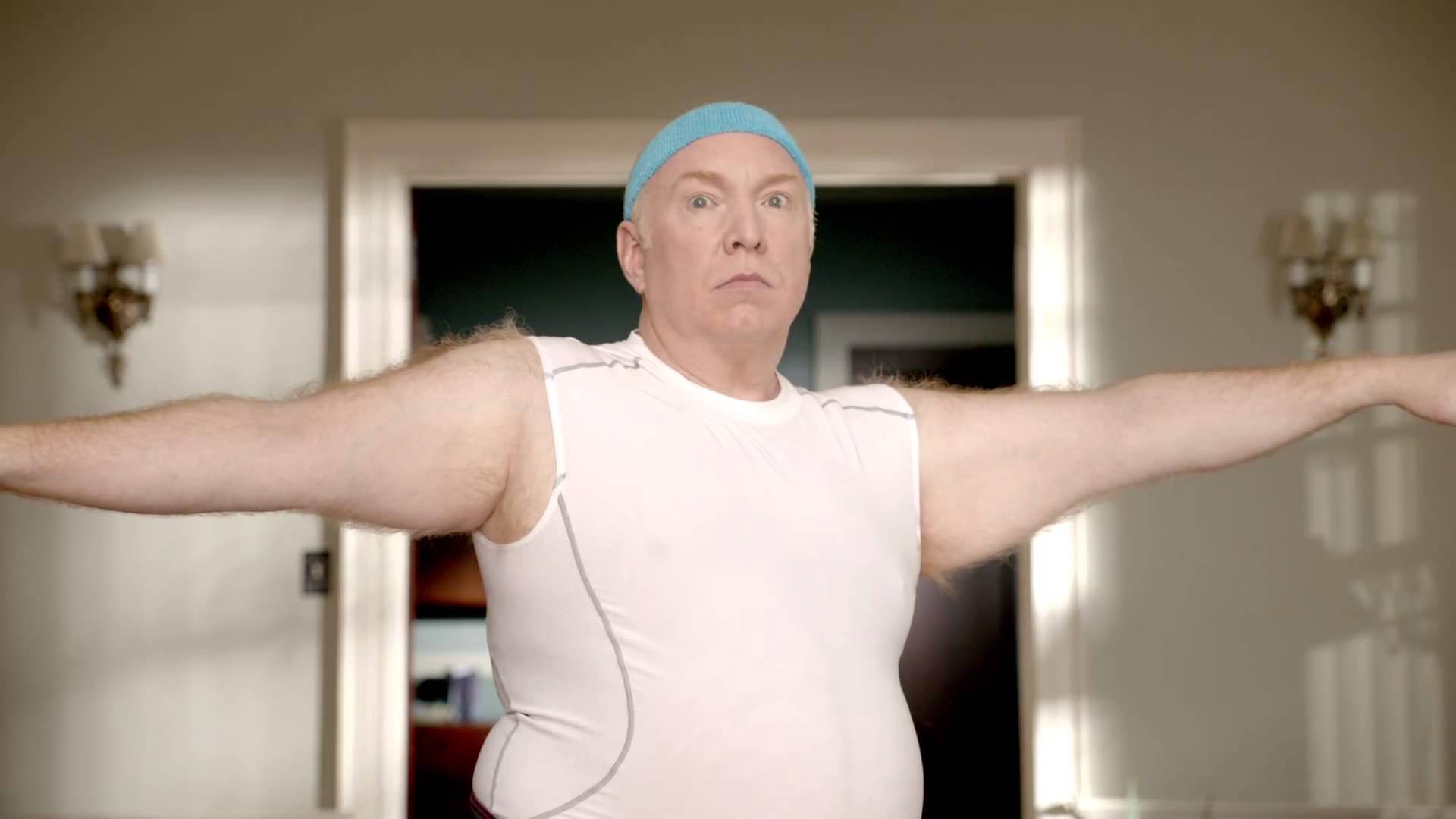
It’s easy to see this letter as an isolated incident, or perhaps even a hoax.  (Although the letter was supposedly sent to the friend of somebody I know online, and I tend to believe it is real.)  But clearly this notion of not wanting to look at fat exercisers is fairly pervasive.  In fact it’s enough of a universal idea that a company that sells blinds used it to create a highly offensive ad with a fat, hairy, male yogi.
yogaguy

ZOMG! Fat Yoga Guy! It’s the apocalypse!

Hot urban couple walks by the window and sees hairy yoga guy.  Everybody looks shocked!  Yoga guy goes out and gets new blinds.  Ah, no more unsightly yoga practice.  NamasFREAKIN’te!

(Ragen Chastain does an excellent job breaking down this ad and giving you special activism opportunities in her blog here and here.)

Look, I make no secret of the fact that I believe exercise is for every BODY.  Whatever your weight, I believe that exercise should be a safe, positive and accessible option for you.  That means you should be able to exercise in public–even (gasp) outside.  That means people who don’t like looking at it are welcome to take the extremely simple and cost free option of not looking.  And if those people don’t like it, they are cordially invited to keep their opinions to themselves.  We don’t yell nasty things at fat people exercising.  We don’t throw eggs at them.  We are grown up adults who can learn to act like it.

That’s how a sincerely concerned neighbor really acts.

In the meantime, all y’all keep gettin on with your bad selves.  And if you want to see some fabulous fatties getting into their fitness groove (with fabulous Flying Rhino shirts no less) trot on over to the Fit Fatties Forum and take a look.

And if you’d like to make the world a better and safer place for exercisers of ALL sizes,  Click here to register for the Fat Activism Conference!  I promise it will be excellent.

And as always, if you want to get free stuff including a fabulous newsletter from me, join the clique here.

Love, Jeanette DePatie (AKA The Fat Chick)


Powerful new Resource Helps Medical Professionals Understand HAES.

I am very excited to tell you about an epic new article that has appeared in the Journal of Obesity.  This article called, “The Weight-Inclusive versus Weight-Normative Approach to Health: Evaluating the Evidence for Prioritizing Well-Being over Weight Loss” reviews much of the available literature on doctors and weight loss and comes to a very firm conclusion: our medical obsession with weight loss is not making us any healthier.  The article defines the difference between the Weight Inclusive and Weight Normative approaches this way:

In this paper, we review evidence that challenges the weight-normative approach for health promotion and offer evidence to support a weight-inclusive approach for health promotion. Instead of imagining that well-being is only possible at a specific weight, a weight-inclusive approach considers empirically supported practices that enhance people’s health in patient care and public health settings regardless of where they fall on the weight spectrum [1, 2, 22]. These approaches differ in the emphasis each one places on weight. While health care professionals using either approach may share some commonalities (e.g., recommending similar self-care practices), they contrast in the relative importance they place on body weight in the context of health and medical treatment, their perceptions of the malleability of weight, and how they respond to patients based on their weight.

The article is very long and rich and cites hundreds of sources.  But I thought I’d pull out

10 things you can learn about weight-focused healthcare in this article:

1.  Recommending weight loss is actually a less conservative approach than recommending HAES because there are negative consequences associated with weight loss attempts.  Thus prescribing weight loss can go against the edict to “first do no harm”.

2.  The data do not support the notion that higher BMI causes poor health outcomes.

3.  Prescribing weight loss supports the notion that permanent weight loss is largely under a person’s control, and that fat people cost society more money.  Neither of these notions are supported by the data.

4.  Weight bias not only exists, but is common in clinical environments.  This is a part of the general increase in weight stigma in the wider world, and weight stigma is dangerous to your health.

5.  Not only does weight loss not work on a permanent basis, but weight cycling (the common result of repeated weight loss attempts) is dangerous for your body.

6.  Obsession with weight loss has led to an increase in eating disorders.

7.  But there is another way.  The  weight inclusive approach focuses on weight as a simple data point in a much larger view on health and focuses on positive behaviors.

8.  The basic principles of the weight inclusive approach are these:

1)Do no harm.

(2)Appreciate that bodies naturally come in a variety of shapes and sizes, and ensure optimal health and well-being is provided to everyone, regardless of their weight.

(3)Given that health is multidimensional, maintain a holistic focus (i.e., examine a number of behavioral and modifiable health indices rather than a predominant focus on weight/weight loss).

(4)Encourage a process-focus (rather than end-goals) for day-to-day quality of life. For example, people can notice what makes their bodies rested and energetic today and incorporate that into future behavior, but also notice if it changes; they realize that well-being is dynamic rather than fixed. They keep adjusting what they know about their changing bodies.

(5)Critically evaluate the empirical evidence for weight loss treatments and incorporate sustainable, empirically supported practices into prevention and treatment efforts, calling for more research where the evidence is weak or absent.

(6)Create healthful, individualized practices and environments that are sustainable (e.g., regular pleasurable exercise, regular intake of foods high in nutrients, adequate sleep and rest, adequate hydration). Where possible, work with families, schools, and communities to provide safe physical activity resources and ways to improve access to nutrient-dense foods.

(7)Where possible, work to increase health access, autonomy, and social justice for all individuals along the entire weight spectrum. Trust that people move toward greater health when given access to stigma-free health care and opportunities (e.g., gyms with equipment for people of all sizes; trainers who focus on increments in strength, flexibility, V02 Max, and pleasure rather than weight and weight loss).

9.  Along with the data that shows the weight normalization (weight-loss focused) approach is ineffective and harmful, is significant data showing the weight inclusive (HAES-oriented) approach is more successful, and that it does not share the negative side effects of the weight normalization approach.

10.  With these thoughts in mind, it makes sense to move to a weight inclusive approach in both personal and public health and actively work to reduce stigma both within and outside of the world of medicine.

I urge you to take some time to work your way through this epic piece of work.  And I urge you to print a copy and bookmark this for sharing at a later date.  Maybe you could take this along to your next doctor appointment.  Maybe you have a friend that is struggling with health care that can use the data to his advantage.  In any case, I’m very, very excited about this and couldn’t wait to share it with you.

Love,

Jeanette DePatie (AKA The Fat Chick)

New Slacker Shocker Appliance Designed to Jolt Fatties into Compliance

Move along. These are not the Wonder Woman bracelets you were looking for.

Okaaaaaay.   So today I read about a new bracelet that is coming on the market that will give you a respectable electric shock if you don’t exercise.  This thing is the Fitbit meets the Spanish Inquisition and it scares the living crap out of me.  It tracks your daily steps and should you fail to meet your quota ZAP!  Don’t get up on time? POW!  Don’t get your daily free weights power lift in? KABLAM!

Oh how can I even begin to explain all that is wrong with this picture?  It looks like a superhero bracelet. It SHOULD be a superhero bracelet, because that would be cool.  Instead it is a torture device designed to disconnect us from our bodies, disconnect our own experience with exercise and infantalize us to the point that we are functioning like lab rats in a freaking maze. 

AAAAAARGH!  Let me lay out 10 reasons why I think this is the exact opposite of what what we want to do for exercisers:

1.  This stupid thing supports the idea of no pain, no gain.  This idea MUST DIE as it convinces people to work out in a way that is unsustainable, causes injuries and prevents them from exercising.

2.  This stupid thing associates exercise with something extremely unpleasant instead of something deeply awesome and wonderful.

3.  If you hate your exercise program so much that you would rather experience torture than do it, I humbly suggest that you need to find a new program STAT!  Exercise should be fun.

4.  Rather than seeing exercise as a loving thing we do for our beautiful bodies, this stupid thing encourages us to see exercise as a punishment for not having the right body.

5.  This stupid thing encourages me to think of myself as less than human.  I have to use torture to do what’s good for me because I can’t be trusted.

6.  Company wellness programs are already punishing people who refuse to use biometric recording devices to track their “habits”.  How long before my boss can deliver a shock to me for not meeting corporate wellness goals?

7.   Eventually it won’t be enough to sit around in the locker room with stinky, sweat-stained garments.  You’ll need to be sporting one of these to prove your commitment.

8.  This stupid thing is the fitness equivalent of a purity ring.

9.  Anyone think it’s a coincidence that this thing is in development at the same time as Shades of Grey the movie?

10.  Yellow and black just don’t color coordinate well with my wardrobe.

I could go on and on.  The only bright side I see to this is a side market in these bracelets that have the shock thingy removed.  All the cool with none of the zap!  I’d love to hear your thoughts in the comments section.

Love,

Jeanette DePatie (AKA The Fat Chick)

Greater Than the Sum of Our Parts (Boobs, Bellies and Butts)

beautiful woman gets a tattoo

Over the past week or so, a number of things have floated across my path about the objectification of fat bodies.  Whether meant for good or for ill, the objectification of any body is not good.  Whether fat or thin, we are not simply boobs and butts and bellies that happen to be floating around in space.  We are people–whole and complete.

While both fat and thin people suffer from objectification, it seems there are some sorts that are more common for fat people than thin.  One is the “headless fatty syndrome”.  Anybody who has ever read or watched anything about fat people in the news ever has encountered the headless fatty syndrome.

Headless fatty is a term coined by activist Charlotte Cooper which refers to photographs or video of anonymous fat people used in news media stories about obesity. The term was created in 2007 when Cooper first noticed the trend in anxiety-laden news coverage of the Global Obesity Epidemic and the War on Obesity.[1] A “headless fatty” photograph features one or more fat person, usually in a public place and unaware of being photographed, with his or her head cropped out of the image. Cooper argues that this representation of fat people is dehumanizing, decontextualizing, and results in the continued disenfranchisement of fat people.

As Charlotte notes in the above definition, showing a fat person in this way treats them as somehow less than human.  It characterizes them as bellies or butts walking around and not as unique people with needs and wants and talents and personalities.

One of my famous friends also went off on a journalist who recently interviewed her for a piece festooned with decapitated and chubby torsos.  While she admits that the journalist may have not been responsible for choosing these images (often the publisher adds them after the story has been written), she says the journalist should have insisted that respectful images be used.

The reality is that using “headless fatty shots” in the media is currently completely unnecessary.  There are several stock libraries available which include whole fat people doing a variety of amazing things like cycling and dancing and eating vegetables and going to the doctor.  Two notable libraries are available at stockybodies.com or the Rudd Center.

The Rudd Center claims that they created their stock image library after an analysis showed that over 65 percent of overweight/obese adults and over 77 percent of overweight/obese young people were portrayed in a negative light.  Images in both stockybodies and the Rudd Center library may be used by the media free of charge.  So there really is no excuse for using the headless fatty shot.  It costs less than many of the stock images media outlets are already using.  The only reasons for still using these shots are prejudice and/or laziness.

But quite aside from the headless fatty trope, I came across another fascinating video this week (CAUTION NSFW):

This video is interesting to me for so many reasons.  First of all, I want to give a shout out to button poetry.  They are posting some righteously awesome stuff.  And a shout out to Samantha Peterson, one amazingly talented woman.  But this poem really made me think of how we so often use inanimate objects as references for a large woman’s body.  How we talk about the landscape and the rolling hills of her.  And the problematic nature of so many of the euphemisms we use to talk about fat women.  What does curvy mean?  Does it refer only to model bodies that are amped up hourglasses with nipped in waists and swelling hips?  Are bodies only curvy if they come with large breasts?  Do curvy bodies include round tummies and flattish bums?  And really, aren’t all bodies curvy in some places?  What is the definition of pleasingly plump?  Who is is pleased?  How do we know?  And who the heck really understands what zaftig really means?  And don’t even get me started on how the comments section of virtually any of my carefully moderated social media outlets define me as an animal–rhino, hippo, elephant, land whale.

In the end, I think it all comes down to seeing fat people as people.  We have to move beyond our deconstruction.  We must insist that we are seen as more than a collection of boobs and bellies and butts and seen in our rich, beautiful, sophisticated, personal entirety.  We must be allowed to inhabit the media and the world in all of our glorious, individual richness.

Love, Jeanette DePatie (AKA The Fat Chick)

P.S.  Don’t forget about the Fat Activism Conference coming up soon. Click here to register for the Fat Activism Conference!

P.P.S.  Get access to free stuff!  Join my mailing list HERE.

BACK (sorta)


Hello my dear readers.  As you may have noticed, I’ve been gone for a while.  Fortunately I had the opportunity to meet and speak with over 400 schoolteachers this past week and share the word about shame-free fitness and Health At Every Size for children.  It was wonderful, engaging and fun.  It was also a set of 7 grueling days with a very intense schedule.  Nevertheless I planned to continue blogging while away.

Alas, the universe had a different plan.  Shortly after I started at the conference, I reached for a piece of paper in my bag and something in the region of my lower back and right hip went completely out of whack.  My friends at the conference insist that it makes a better story that I hurt myself busting a move, that the limbo initiated my lumbago or SOMETHING.  But the truth is, I was sitting in a chair reaching for something in my bag, and I had that MOMENT.  There’s a moment when time stops and that surprising pain comes and all you can think is “WHOOOOOOAAAAA, that can’t be good!”.

I managed to fulfill all my obligations at the conference and even have some fun.  But sitting aggravated my pain the most and I simply couldn’t bring myself to blog last week.  Sorry about that.  But I thought I would take this moment to share a few thoughts with you about my back experience.

1.  Sometimes poop occurs.  It just does.  I could make myself crazy wondering if it was tension or a posture problem or lack of sleep or the size of my hips or the tilt of the universe that caused that pain.  But at the moment that the pain occurs I need not to focus on that.  I just need to deal with it.

2.  Dealing with it means that sometimes your plans have to change.  When pain or a serious setback happens, it’s time to reorganize priorities.  Some stuff will not get done.  You can either triage and choose which things you can do, or you can try to do everything and end up able to do nothing.  You wanna know how I know?  Experience.  So many times, I’ve been in denial about the fact that I can’t do everything.  So many times I’ve ended up at that point, in pain, completely spent, where I can’t do anything.  I really don’t want to do that any more.

3.  Pain is a sign that something is out of whack.  It could be posture.  It could be schedule.  It could simply mean something in my body isn’t working properly.  As I am healing this week, I will start, very gently to figure out what is out of whack.  I’ll see my doctor and start reviewing things in my life to see if I can figure it out.  But I may have to accept that the discovery process may be long and challenging.  And I may have to accept that I can never figure out exactly what caused this episode.

The good news is that hundreds of school teachers, councilors, administrators, and other employees were exposed to the notion of shame-free exercise and the Health At Every Size(TM) approach to wellness–many for the first time.  So I’m going to take an aspirin and take my leave glad for a job well (if shakily) done.

Love, Jeanette DePatie, AKA The Fat Chick

P.S.  Don’t forget about the Fat Activism Conference coming up soon. Click here to register for the Fat Activism Conference!

P.P.S.  Get access to free stuff!  Join my mailing list HERE.

ESPN Hits It Outa the Park with New Cover Model

OMG I am so excited that ESPN chose studly baseball man Prince Fielder as the cover model for their 2014 Body Issue.  Far from the typical wasp waisted, v-shaped Adonis types, Fielder’s muscular and substantial physique is a breath of fresh air.  While the Texas Rangers star shares some concern about a need to fuel his work with healthy eating habits in this decidedly NSFW video here, he also shares some candid thoughts about how he loves the skin he’s in.

Fielder: You don’t have to look like an Under Armour mannequin to be an athlete. A lot of people probably think I’m not athletic or don’t even try to work out or whatever, but I do. Just because you’re big doesn’t mean you can’t be an athlete. And just because you work out doesn’t mean you’re going to have a 12-pack. I work out to make sure I can do my job to the best of my ability. Other than that, I’m not going up there trying to be a fitness model.

And it takes even more courage to say these things in light of the fact that he’s recovering from surgery to repair a herniated disc in his neck.  He talks about the path of his physical therapy and says, “I can’t do much of anything right now.  I just have to let the process of healing take place.”

I think I might just be a teensy bit in love with Fielder.  He represents so much of what I think is important about fitness.  He’s way more focused on what his body can do than how it looks.  He understands the need to rest and heal from surgery and injury.  He’s lovingly caring for his body so he can get back to using it to do stuff that he really loves.  And he’s quite okay with the fact that he doesn’t look anything like a male underwear model.  *Swoons.* 

While every magazine can always do more to promote body diversity, I’m pretty impressed with the step ESPN took with this cover model.  And as long as you make a firm commitment with yourself not to read the comments (no feeding the trolls) I think you will derive a fair amount of encouragement from this as well.  Sure they’ve got Michael Phelps.  He’s a beautiful athlete.  But his body is trained to do something very different than Fielder.  So of COURSE Phelps and Fielder are going to look different.  That doesn’t mean that they can’t both be beautiful.  And as the French say, vive la difference!

Love,  Jeanette (AKA The Fat Chick)

P.S.  Learn more about making the world safe for folks of all shapes and sizes at the upcoming Fat Activism Conference here. P.P.S.  And don’t forget to join my mailing list and get free stuff!

Women (truly) Kicking Butt and Taking Names in Male-Dominated Sports

Samantha Swords
Over the past few days, I have run into stories of some absolutely fabulous women kicking butt in sports traditionally populated only by men.  And when I say traditionally, I mean like long centuries of deep, masculine culture and history of manstuff.  It’s so cool!

One exciting example is Samantha E. Cato-Mott (AKA Samantha Swords).  She is a trained “European Martial Arts” expert and all-around ridiculously cool Renaissance Woman.  She works as a film props/armor creator, stunt fighter, actress and champion sword fighter.  Last year she not only competed against men in the Harcourt Park World Invitational Jousting Tournament, but also won the Longsword Competition.

You can see and hear an interview with her here:

Also this week, I ran into this piece from the New York Times about women who are competing in the male-dominated world of sumo wrestling.  These women are flexing their muscles and presenting their power in a sport with traditions that span back centuries.

One woman in the interview states:

“It’s one of the few sports where as a big girl, you can actually have physical contact and not have to hold back, and not have to [worry]–Ooo am I gonna hurt him?”

One of the cool things about these women is that they are fighting full out and for real.  They are not hypersexual parodies of fighters, they are warriors pure and simple.  (Although I recommend against spending too much time in the comments section of any of the articles about them if you’d like to keep your sanity points intact.)

I think this is so important for young girls and young women to see.  These women are stepping across traditional gender lines, fighting for the pure joy of athleticism, and kicking butt and taking names.  They are demonstrating that there is room for all of us under the athletics tent.  Whether male or female, thin or fit fatty, there is some wonderful way out there to get your sport on!

Love, Jeanette DePatie (AKA The Fat Chick)

P.S.  Learn more about making the world safe for folks of all shapes and sizes at the upcoming Fat Activism Conference here.

P.P.S.  And don’t forget to join my mailing list and get free stuff!

Hubris can be Bad for your Career, Bro.

AdamRichmanLostWeightSo Adam Richman, a guy who was originally famous for eating massive amount of food on a dare on cable television, lost some weight.  The star of the Travel Channel’s extremely lucrative show “Man vs. Food” lost over 60 pounds and as the picture above indicates he wants everybody to know it.  That’s all well and good.  We’ve all been there.  It’s part of the weight loss cycle.  The post-weight-loss, check me out in my skinny jeans euphoria.

So Adam Richman likes to post pictures of his new, skinnier self on Instragram (fine) with the tag “thinspiration”.  (Cue record scratch, car screeching to a halt, hold the dang phone noises.)  In case any of you are not familiar, “thinspiration” is a tag often used by people with anorexia and bulimia specifically to mark images of very thin or emaciated people to help “inspire” them to continue their disordered behaviors.  It’s okay if you didn’t know that.  It seems likely that Adam Richman didn’t know that either before he blithely used it in a public forum to document his weight loss.  Again, this mistake is understandable and probably forgivable.  It’s what happened next that caused the proverbial manure to hit the proverbial propeller.  When some fans tried to point out to Richman that he probably shouldn’t use the “thinspiration” tag, given its association with eating disorders, which by the way are pretty serious, and by the way kill people, Richman kind of lost his mind.  What ensued was an epic temper tantrum and classic case of celebrity hubris.

He responded to one person who politely pointed out the whole “thinspiration” tag issue with:

“(DILLIGAF, aka, “do i look like I give a f–k?”)”

So size activist Amber Sarah got on her personal Instagram account and encouraged her followers to write to Adam and tell him that eating disorders are no joke, that people die from them and that he should reconsider.  I think it would be fair to call Richman’s response “ill condidered”.

Among his responses were:

…Give me a f#$%%ng break.  If someone acts like a c$%t I’ll call them one.  It’s not misogyny, it’s calling a spade a spade.  Maybe you’re the one being aggressive & unfair and yes – if the use of the hashtag offended you, it was unintentional & for that I’m sorry.

Okay.  Let’s score this effort.  10 points for calling a woman a c$nt and then saying it’s not misogyny.  10 points for the spade a spade analogy (which boasts some deeply racist roots).  10 points for insulting black people and women in one little text, yelling at somebody who is calling out his behavior and privilege as unfair  and managing to finish up with a no-pology towards people suffering from eating disorders.  Dude.  This coulda been so simple.  If  you had just deleted everything in this post before  “It was unintentional & for that I’m sorry” you’d have been home free.  Some people would have still been mad, but it would have all ultimately calmed down.

But no.  He went on to post this little gem:

No, I legitimately don’t give a f$%k about haters & closed-minded internet loudmouths like you.  At all.  And don’t come to me with childishness when a hashtag throws you into a tizzy of comments about “never watching you again.”  Seriously, grab a razor blade & draw a bath.  I doubt anyone will miss you.

And this one:

Oh, eat a bag of sh#t dummy.  No apology is coming.  If it inspires somebody to attain a healthy thinner body – then that’s what it was meant to do.  Only f$%k up it seems is your Dad’s choice to go without a condom.


Okay.  So somebody calls you out for being unintentionally insensitive and among the responses you call women c#$ts, call a spade a spade and follow it up by suggesting that those who called you out should kill themselves because they never should have been born?  It’s perhaps not surprising if people find the ensuing “apology” you made after you started worrying about, I don’t know, not having a job the next day, a little disingenuous.

And the apology was also managed in fits and starts.  It was up on twitter and taken down, it was up on Instagram and taken down.  Finally, he apologized on Good Morning America saying “I’ve long struggled with my body image and have worked very hard to achieve a healthy weight. I’m incredibly sorry to everyone I’ve hurt.”

Nevertheless, The Travel Channel has announced that his upcoming show, “Man Finds Food” has been pulled off the schedule indefinitely.

Which leads me to the premise I laid out in the title.  “Hubris can be bad for your career, bro.”  Hubris: n. 1) Pride or arrogance.  2) In Greek Tragedy an excess of ambition, pride, etc, ultimately causing the transgressor’s ruin.

It’s perhaps not so surprising that Richman thought he could get away with publicly eviscerating fat people.  Lord knows he received his share of fat shaming as the star of Man vs. Food.  But as Paula Deen and Dov Charney and Terry Richardson are finding out, there is a point of no return.  Sexually assault and harass women and you could lose your job and the company you’ve spent your whole life building.  Tweet that fat people shouldn’t earn a doctorate and expect to be hauled up for some pretty serious disciplinary action.  Express profound racism even when you think you are in private and lose your show and your entire empire.  Tell people who call you out for racism and privilege and prejudice that they should kill themselves or should have never been born watch your new show get cancelled before it even airs.

Look, we all make mistakes.  But when you are a celebrity, and you make those mistakes in a very public forum like Instagram, there is a cost.  And just to be clear.  Deleting your mistakes after the fact, in a world where you can make screen shot with one little click of the mouse, is really not gonna work.

And frankly, I’m glad.  After all, those of us who write about rights for people of all sizes receive a lot of hate mail.  We have people calling us names every single day.  Some of us receive hundreds or even thousands of messages on social media in a single week telling us we are worthless, a scourge on humanity, we should have never been born and we should kill ourselves.  And frankly, seeing even a single person experience some consequences for this behavior is a little bit encouraging.

Love, Jeanette DePatie (AKA The Fat Chick)

P.S. Want to learn more about rights for people of size?  Ragen Chastain and I are hosting a Fat Activism Conference in August!  Click the banner below to register!
Fat Activsm Conference Registration Page
 

Star Trek and the Two Minute Chair Workout

Best exercise chair EVAR!

One of the things I hear quite often on the Fit Fatties Forums or in emails is, “I can only do two minutes of exercise or I can only exercise in a chair.  Sometimes I feel like why bother.  I used to be able to exercise a lot and now I can just do this much.  I’m so embarrassed.”

First let me say, I feel ya.  Sometimes it seems like everyone around me is doing marathons or ultra-endurance events or walking for three whole days in a row for a cure.  Sometimes it seems like everywhere I look, somebody is dashing off an effortless 2 hour workout, glistening and smiling while climbing mountains, lifting huge weights and cycling the Great Wall of China.

And I have to remind myself to feel happy for them.  That it’s not kind or productive to feel jealousy or hatred towards them or to sit on them until they stop looking so athletic-y and agree to sit and watch re-runs of Game of Thrones with me.  And I have to remind myself that every athlete, and I mean every athlete had to start somewhere.  And every athlete has had setbacks that have made them slow down, go backwards in their training and build gradually back up.

I have had several major injuries, surgeries and illnesses over the years that have put my training on hold or brought it to a screaming halt.  I have had to go back to exercising one or two minutes at a time and gradually come back to a higher fitness level.  And you know what?  It kinda sucks.  It really kinda sucks to have to go backwards in your training and slow down and start again.  It kinda sucks to remember how easy exercise was when you were twenty and to feel what it’s like start up again at forty, fifty or eighty.

But you know what, we don’t all START as starship captains.  And starting is way better than dreaming about imagining the process of starting.  Two minute workouts are way, way better for your body than no workouts.  And exercise in a chair can be a safe and wonderful starting place if standing workouts aren’t comfortable or safe for you right now.  And if a two minute chair workout is something that you can do safely  and consistently and relatively comfortably at this point, then I would say that a two minute chair workout should ROCK YOUR WORLD RIGHT NOW!  And I’m going to let Captain Kirk and Spock tell you why.

If we look at this exercise thing with cold, Vulcan Spock-like logic, it’s fairly plain that one of the most important things is to live to exercise another day.  Now I don’t mean that you’re actually going to die after your workout (at least I hope not).   But it’s really, really common for beginning and returning exercisers to do way too much too soon.  If you’re lucky, you simply hurt all over the next day.  This does not inspire most of us to do another workout.  If you’re coping with a chronic illness or condition, you may find yourself so weak and exhausted that you can barely move the next day.  You may find that you have inadvertently used up a whole week’s worth of “spoons” in one go.  If you’re recovering from an injury, you may find that you have severely aggravated the injury site.  Or if you are even less lucky, you’ll re-injure yourself or have a brand new injury to deal with.  All in all, doing way too much too soon is not something to be proud of or wear as a badge of honor.  From a cold logic standpoint, it’s kinda stupid.

Because there is an alternative.  If you start small, at a level that is comfortable to you, and if you increase gradually, at a level that is safe and sensible, you don’t have to go through massive amounts of pain and injury and frustration.  You can progress in your fitness efforts without having to quit and go back to zero all the time.  You can spend a whole lot less time visiting your doctor or sports medicine specialist.  You can integrate exercise into your life without it taking over your life.  You can expend a reasonable amount of “spoons” on working out and still have some left for washing your hair and taking the kids to school.  Exercise will feel great and you will feel like doing more.  And if you ask your inner Spock, he’ll tell you that this is the smart move.

After that, you just have deal with your inner James T. Kirk.  First you have to tell your inner Captain that he needs to calm the heck down.  He will tell you to run out, phasers blasting, smart mouthing and fist fighting every sassy alien that comes along.  But let your inner Spock remind him of the need to live to fight another day.  Then let your inner Kirk remind you that you can cope with most things with a swagger and a smile–including a two minute chair workout.  Stubbornly refuse to be embarrassed by it.  Have fun with it.  Rock it out.  Gradually, increase.  And before you know it, you’ll be exercising more than you ever thought you could, feeling better and having a better quality of life.  And then you can truly, live long and prosper.

Love, Jeanette DePatie (AKA The Fat Chick)

P.S. Want to get free stuff, including a new bonus in July?  Join my mailing list HERE.

Scientists Say they may have Underestimated Fat Hatred. I say, “Yup!”

Wow, what a week.  On the one hand I got a nice mention in Women’s Health magazine.  On the other hand, a rabid group of haters found my YouTube channel and I’ve spent the week combing through literally thousands of very hateful and unbelievably stupid comments to see if I could post any of them on the site.  The answer is, “nope”.  But I do need to shout out and say “Thank You Haters” for bumping up my views even if they are to leave me comments about my sexual preferences, my intelligence and my smell that will never see the light of day.

And right smack in the middle of this crazy week, I came across this press release about a recent study that indicates that fat stigma may be a lot more prevalent than they originally thought.  It turns out that a lot of the previous studies that attempted to measure weight stigma relied on people remembering episodes of fat hatred from as far back as 30 years ago.  Not surprisingly, people recounted some very severe stories of weight stigma, but reported that weight stigma didn’t really happen that often.  A new study from Western New England University used a different approach to measuring weight stigma.  They are the first to use a daily diary approach to measure incidents of weight stigma among fat women.  It’s probably not that hard to imagine that the Western New England University study found that weight stigma was more common than originally thought.  And I mean a lot more common.  50 “overweight” and “obese”* women were studied.  Over the period of 1 week, the women reported 1,077 stigmatizing events.  That averages out to 3.08 events per person per day.

What’s more, Jason Seacat, Ph.D., associate professor of psychology at Western New England University in Springfield, Massachusetts and the study’s lead author says that the source of this stigma might surprise you.  “A surprisingly high number of stigma events came from close family members or friends,” Seacat says, citing experiences like a woman whose boyfriend’s mother withheld food and called her lazy.  He goes on to say:

“We have probably underestimated the size of the weight stigma problem,” he says. “People are encountering more barriers on a daily basis than is reported in the literature. Standing in line and overhearing someone comment on your size, having to ask for a lap band extension on an airplane, going into a clothing store and not finding something in your size… Those are all stigmatizing events, but we as a general public might not realize the effects those events can have on people.”

I have to admit, that it’s mighty tempting for those of us that are perpetrating the crime of living in the world while fat to respond to all of this by saying, “Duh!”  When you are filtering your 37th email in one day calling you a fat c**t, you might be tempted to call Mr. Secat Captain Obvious.  Even so, I’m glad we are doing more to measure this problem in a more meaningful way.

Because I’m sick and tired of hearing about how we are being oversensitive.  I’m really done with hearing people tell me that fat folks are not really oppressed–that asking for basic human rights while fat is some sort of crime against decency and humanity, and that we should just stop eating and stop whining and consent to be miserable.  And all of this denial of fat oppression is happening at the same time that fat grad students are told “not to bother” applying for a doctoral program, and that fat people can’t be researchers or scientists because they just might more than their share of the departmental pizza.

So, yes.  I’m very grateful that this research is being done.  Just don’t expect me to be surprised by these results.

Love,

Jeanette DePatie (AKA The Fat Chick)

P.S.  Wanna get free stuff?  Click HERE to join my mailing list!

*This is what the study called them.  I’d just call them fat.