Category Archives: Uncategorized

An announcement plus Stuff that Weighs More than Me: World’s Biggest Chess Piece

IMG_0985Okay, so we have a few things to talk about today.  One is to share with you my latest entry to stuff that weighs more than me.  In the above photo, I am posing next to the world’s largest chess piece.  I encountered it completely by chance in the Central West End of St. Louis today.  I stopped for lunch and there it was, in all it’s geeky glory–a really, really giant chess piece.  I looked at my husband and he grinned as he said, “Do you want a photo for your blog?”  “Heck yeah,” I replied.  “I’m quite sure THAT weighs more than me.”

IMG_0987

Indeed it does.  As the above photo indicates, the chess piece is as tall as a giraffe.  And were it used in an actual game of chess, it would require a chess board measuring over 70 feet per side–large enough to park 12 school buses.  Here’s the stats:

Height: 14ft. 7in.

Width: 6 ft. at the base

Material: 3/4″ plywood

Weight: 2,280 pounds

Conclusion: whether king or pawn, the world’s largest chess piece weighs more than me.

And now for the big announcement!  I’m thrilled to report that this blog was selected as one of the 2014 Top Positive Body Image Blogs and sites by Body Bliss Central!  W00t!  With special thanks to Ragen Chastain for the nomination!

Looking forward to heading for home and sleeping in my very own bed soon!

Love,

Jeanette DePatie

AKA The Fat Chick

P.S. Don’t miss a single post! Subscribe!  Subscribe!

Taking a Vacation from a Common Equation: Calories in, Calories Out

Myrtle, Esther and Bessie take a little trip outside of their comfort zone...

Myrtle, Esther and Bessie take a little trip outside of their comfort zone…

For the past few days, I’ve been back in Missouri.  First we went to Rolla where my husband was presented with an honorary degree for his ongoing work in computer science.  (Seriously, how cool is that?)  And now we’re in St. Louis catching up with some of our friends that we haven’t seen in a few years.  So I thought this morning I would talk about being on vacation and how it might apply to my work in size acceptance.

One thing that being on vacation can do is give you a broader perspective on how people live in other parts of the world.  One thing that I ran across this week (as I was “on vacation” from doing more productive work on my computer) was this article containing 23 photos of people next to how much food they eat per day.

Marble Moahi, Mother Living with HIV/AIDS, Botswana – 900 Calories

What struck me so much about these pictures, besides the fascinating variety of different types of food consumed was the drastic differences in calorie consumption among these people.  The Botswana woman above is pictured with the meager meals she eats each day totaling just 900 calories.  Compare that with the picture of the man below.

Willie Ishulutak, Soapstone Carver, Canada – 4,700 Calories

This fellow is pictured with over 4,700 calories which he eats each day.  Notice anything interesting here?  How about this.  Willie Ishulutak eats over 5 times as many calories as Marble Moahi.  Now there is little question that some of Willie’s calories are, um, liquid.  But he clearly consumes a lot more calories than she does.  And while Marble is somewhat thinner than Willie, neither of them appear to be particularly fat.  This goes against the grain of what many of us have been taught about bodies and nutrition right?  If we use the old adage of calories in calories out, Willie should appear a whole lot fatter than Marble.  But lo and behold, it just ain’t so.

I would like to invite you to explore this article and these photos with me.  And I would like you to join me on a vacation over the notion that if fat people just ate less and exercised more they would be thin people. These people could be lying about what they eat.  I’d love for you to take just a little time off from the adage “calories in, calories out”.

Now to be fair, this photo essay hardly constitutes a formal study on the notion of calories in, calories out.  The photo subjects could be lying about what they eat.  The photographer could have selected an atypical day’s worth of food for the photo shoot.  But we’re on vacation right?  So what if we took just a little time off from assuming that fat people lie about what they eat or that thin people exaggerate how much or how little they eat?  What if we just took a little time to assume that both Marble and Willie are telling the truth?

The next logical step might be to assume that Willie burns 5 times as many calories as Marble.  While this is certainly possible, it seems unlikely in the extreme.  If we assume that Willie is a 150 pound man (which is a very rough estimate), he would burn approximately 430 calories per hour walked at a brisk pace.  Willie consumes 3800 calories more per day than Marble.  Taking brisk walking as a calorie burning exercise, he would need to walk 8.8 hours more per day than Marble in order to burn all of those extra calories.  I suppose it’s possible.  But let’s just take a little trip past the notion that Willie walks a marathon or two every day in order to “keep his figure”.

Look, I am not suggesting that there is no relationship whatsoever between calories consumed and body size.  It seems logical to assume that some relationship is there.  But I wonder if we could agree, at least temporarily that it is not that simple.  So many of us have had “calories in, calories out” thrown at us from so many directions.  Sometimes it seems that everybody from our online haters to the surgeon general of our nation is eager to suggest that if we ate just a little less, and exercised just a little more we would be thin.  But I’d like to invite you to punch the time clock and walk away from this notion for just a little while.

I am far from expecting that I will change the world or even change your mind with my little blog over here.  But I do hope that from time to time I am able to “give you pause”.  I hope I can help you step outside of our culturally held beliefs about weight, food, exercise, health and more.  Because sometimes just a little time away is all we need to reenforce the idea that the world is quite a bit more complicated than the advice offered around the water cooler.  Sometimes life doesn’t fit into neat and tidy axioms–no matter how much money is spent trying to make them.  And while we might not be ready to give up some of these simplistic ideas completely, maybe you could try a little time off and see how it feels.  Who knows, after a few weeks you might be ready to adopt some of these new ideas full-time.

Love,

Jeanette (AKA The Fat Chick)

P.S. I would love to invite you to take another Virtual Vacation with me on the Fit Fatties Forum!  We’re moving our bodies as we explore the world.  And tomorrow is the last day for super early bird pricing!  CLICK HERE to learn more.

Also, if you’d like to learn more about fitness and health and get FREE STUFF, be sure to join my mailing list here.  Let’s keep in touch!


Does Eating Margarine Cause Divorce? Correlation is not Causation.

There’s a lot of buzz on the list serves about a new website that just launched called Spurious Correlations.  The site reports a new “correlation” each day.  For example, the site points out that the correlation in Maine between eating margarine and divorce is over 99 percent.  Does this mean that Maine residents who want to maintain their matrimonial bond need to switch right on over to butter?  I mean 99 percent seems pretty darn compelling, right?  There are lots of other important correlations listed on the site including:

Per capita consumption of mozzarella cheese and civil engineering doctorates awarded–95%

Honey producing bee colonies and the marriage rate in Vermont–93%

US domestic price of uranium with accidental poisoning by alcohol–97%

Spurious Correlations is a wonderful tool for demonstrating that oh so important axiom, “correlation is not causation”.  This means that just because two things tend to happen together does not necessarily mean that one causes the other.  They might have a third agent which is causing them to happen together or they might have no relationship to one another whatsoever outside of a random statistical similarity.

I think that Spurious Correlations is a fascinating site.  I’ve spent way too much time tooling around in there.  But I also think it is an important tool for helping us understand our world.  Because so many of the people writing and talking about science on websites and blogs, on television, in magazines and newspapers get this relationship between correlation and causation so very wrong.  I think in some cases the writers and speakers don’t understand the difference.  But in other cases, I think the writers are very clear about the difference and simply report correlation as causation because it makes better headlines or sells more product.  Take this blog post for example.  I don’t have any proof that buying margarine causes a single divorce in Maine.  But I imply that there might be a cause by asking the question in the headline: “Does Eating Margarine Cause Divorce”?  It’s easy to see why I did that.  “Per Capital Margarine Consumption in Maine Closely Correlates with Divorce Rate” just doesn’t have the same ring to it.  But I think most people would agree that even though butter tastes a whole lot better, eating oleo is unlikely to be the cause for divorce.  Either something else is going on to connect these two statistics, or they are completely unrelated.  So the difference between correlation and causation here is pretty easy to spot.

But what about the correlation between the total number of computer science doctorates awarded and total arcade revenue.  These two facts correlate at over 98 percent.  And it would be pretty easy to formulate a theory about how these two facts are related.  Maybe when there are more computer science students, it means there are more nerds that love to play arcade games.  Maybe more computer science doctorates means there are more nerds qualified to design and implement great arcade games.  With just the tiniest whiff of a potential relationship, our minds naturally leap to find ways that one of these facts could cause the other.  But there remains the very distinct possibility that there is no causal relationship whatsoever between these two statistics.

I find this particularly relevant in our current national hysteria over obesity.  It seems every week there is a new study claiming that this thing or that thing causes obesity.  And everywhere you look you see “proof” that obesity causes this problem or that problem.  But I think it is important for us to keep our wits about us and take a look whether these studies can sufficiently demonstrate that two correlated facts have a causal relationship.  For example, people are spending more time in front of computer screens than ever before.  Some have suggested that increased screen time causes obesity.  But do we know that is true?  Or are these things simply happening at the same time.  We also have more 24 hour gyms than in the previous century.  Is it reasonable to suggest that the increase in 24 hour gyms causes obesity?  Maybe dieting causes obesity, or exposure to certain plastics?  Heck, based on the correlation, one could easily suggest that talking about obesity increases obesity levels!  And how about the rise in medical insurance costs and the rise in obesity.  Does a larger number of fat people cause higher insurance rates or is there something else going on?  The question of the rise in health insurance rates is detailed and complex but how many people have simply jumped to the conclusion that the fatties are making their monthly premiums higher.  How many of us take the time to understand: the only way that we can prove that one thing causes for another is through careful experimentation where as many other variables as possible are ruled out and a causal agent is ultimately found.

So when you come across studies that demonstrate a relationship between say obesity and heart disease or obesity and cognitive function, I urge you not to just jump blindly onto the causation train.  Ask yourself a few questions:

  • Has this study adequately controlled for other causal factors?  Has it controlled for diet, physical activity levels, socioeconomic status, access to good healthcare, education, etc.?
  • Has this study identified a causal link that demonstrates why these two things are happening at the same time?
  • Is it possible that these two statistics are simply randomly related with no causal relationship whatsoever?

That is not to say that correlation never go together.  All causal relationships are also correlations.  But not all correlations contain causation.  These are important facts to keep in mind the next time you read a headline screaming about the causes of obesity or harm caused by obesity–or the next time you decide to buy margarine in Maine.

Love,

Jeanette (AKA The Fat Chick)

P.S.  Want to go on a virtual vacation?  Ragen and I over at the Fit Fatties Forum are launching Virtual Vacations that allow you to exercise while virtually visiting some of the world’s most fabulous cities!


Is Godzilla Yo-Yo Dieting?

Japanese fans are up in arms about the new Americanized Godzilla’s hefty size–citing poor diet as cause for the unwelcome change.

The trailers for the newest Godzilla film have hit American shores and has spawned some significant controversy.  It appears that Godzilla has come “under fire” not for his acting (which has been notably wooden in the past) but for his BMI.  No we are not talking about the Bad Monster Index–where Godzilla holds the undisputed title of King of the Monsters.  We are talking about the Body Mass Index.  Many are currently arguing that Godzilla is just sporting too much weight on his 350-foot high frame.  Using the current BMI, Godzilla could weigh about 750,000 pounds before he hit the dreaded “Obese” category.  Godzilla has not been forthcoming about his weight, but many Japanese fans have calculated that the hapless lizard may have stomped out of the “ideal weight” category.

“He’s so fat I laughed,” was one particularly cutting remark found on Japanese forum 2chan.  Others have referred to him as “metabozilla”, “marshmallow Godzilla” and even “pudgy and cute”.  Some have speculated that Godzilla’s size is due in part to his American diet and sedentary lifestyle.  “That’s what happens when all you do is eat Snickers bars,” said one commenter.

Much of this has led to speculation about Godzilla’s diet.  He has never been shown on screen eating (although he has ingested a nuclear reactor and seemed to absorb energy from that).  He has been seen in comic books eating raw seafood.  Most people guess that he lives largely on radiation and sushi.

It seems pretty likely that Godzilla has to eat quite a bit to sustain is 350 foot high body.  An African elephant weighs in at about 7,000 pounds and needs to eat about 500 lbs. of plant matter per day to sustain itself.  Using that same ratio, Godzilla would need to eat about 50,000 pounds of plant per day.  Now the King of Monsters might be able to absorb some of his energy via nuclear radiation.  And naturally protein sources like fish are more dense in calories than say, trees.  But I ask you, do we really want a creature that needs to eat 10,000 pounds or more of food per day to turn to a protein diet?    So far as we know, Godzilla does not eat people, yet.  But I don’t know if I want to encourage him.

But Godzilla hasn’t always been svelte.  A quick look at his film debut publicity photos in 1954 show a relatively “fluffy” monster with more of a pear-shaped figure.

There is no question that Godzilla has gotten bigger over the years.  Traditionally, the giant lizard has grown larger in proportion to the buildings he stomps around.  The Godzilla of 1954 was a mere 50 meters tall.  The newest Godzilla is over 100 meters tall and noticeably beefier:

But if you look carefully at the creature’s shape, you might notice something very interesting and somewhat familiar.  It’s even clearer if you look at this picture here:

Clearly the great monster’s shape has cycled too.  He appeared to have shed some pounds in the the MusoGogi period (1964) beefed up considerably in the BioGogi period (1989-91) gone through some sort of radical weight loss program in the Shodaijira period (1998) and bulked back up for his current appearances.  Seem familiar to you?  Seemed that way to me too.  In fact, I think Godzilla is experiencing the most common outcome of trying to stay slim.  I think the King of Monsters is weight cycling–probably from yo-yo dieting.

Now there is no way to know for sure.  As my good friend Ragen Chastain says, the only thing you can know about a fat  person (or monster) by looking at them is your own prejudices about fat people (or giant lizards).  But if our good friend Godzilla is experiencing weight cycling, he would certainly be experiencing the same thing that most people who try to lose weight experience.  Most people are able to keep some weight off for a while, but the vast majority of folks (90 percent or more) regain the weight they’ve lost and often a little more.

So this leads us to the question of what should be done about Tokyo’s most famous building-stomper.  I think if we are seriously going to spill digital ink regarding the size of a fictitious reptile who bangs buses together for fun, we should use this as a truly teachable moment.  Let’s talk about what really works in making creatures of all shapes and sizes happier and healthier.  I think the first thing we should do, is to stop trying to shame the poor creature.  There is ample evidence after all, that shame doesn’t help anybody lose weight.  I’m sure the producers at The Biggest Loser are planning epic monster battles between Godzilla and their “Monster Trainers” as we speak.  And even though the King of Monsters’ agent is probably taking calls right now from diet companies seeking his endorsement for the new “Monster Weight Loss Formula”, we should probably discourage him from falling into his old habits of dieting and weight cycling.

I recommend the same thing for Godzilla that I recommend for everybody else.  He should eat a varied diet including foods that he loves (but not including people).  He should engage in joyful and pleasurable physical activities (not too close to major cities).  In fact, I think he should try my DVD.  He should sleep well.   And he should manage his stress (again, hopefully not too close to major metropolitan areas).   At 60 years old, Godzilla is showing no signs of slowing.  If he follows these simple recommendations, he’s likely to stay happy and healthy for many years to come.  Which is good.  Because I freakin’ LOVE this guy.

Love,

Jeanette DePatie (AKA The Fat Chick)

CEO: Every BODY Can Exercise.com


On Golf, Waffle House and Becoming a Professional Hater

Recently, Bubba Watson won what is arguably the most important title in professional Golf–The Masters.  He didn’t go to Disney World to celebrate.  Nope,  Watson celebrated his 1.6 Million dollar winnings by taking his family for a celebratory feast at a Waffle House restaurant.  He tweeted the event to his 1 Million plus followers and the tweet went viral.  The photo shows Bubba sitting next to his wife and best friend (Judah Smith, a pastor from Seattle).  By and large the coverage was positive.  Not only had Bubba managed to win the Masters for a second time, he had brought attention to an event that had primarily received coverage for the fact that Tiger Woods would NOT be attending.  He managed to make a sport that is often seen as the exclusive playground of the rich seem more fun and less stuffy.

But not everyone was complimentary about Bubba’s trip to Waffle House for Grilled Cheese and Hash Browns.  Apparently, self-appointed food policewoman, Katherine Tallmadge recently appeared on Neil Cavuto’s show on Fox recently–bashing Bubba for being a “poor example” of how athletes should eat–at least in public.  Tallmadge fumed:

“Well, it would be great if celebrities and sports figures set a better example for our obese nation,” Katherine Tallmadge huffed to Fox TV host Neil Cavuto.

“There’s nothing wrong with the Waffle House if it’s an occasional splurge, but these gazillionaires love to show Americans that they’re one of you. And so, to win a popularity contest, they go to Waffle Houses, diners, steak places, when in reality, to be a great athlete or a celebrity in good shape, they don’t really eat like that.”

Okay, let’s break this apart, shall we?  This guy won one of the highest titles in the land for one is arguably one of the most nerve-wracking sports on the planet but gets publicly scourged on a national level for eating some hash browns at Waffle House?  Would it be better if he ate hash browns in secret where nobody could see.  Is he failing to sport the fashionable eating disorder that should accompany any person receiving this much public attention.

And apparently, along with basic information about nutrition, registered dieticians receive training in clairvoyance and divination.  Because although Tallmadge really doesn’t know Bubba or anything about his personal life, she feels she can safely comment on:

1.  What Bubba eats on a regular basis.

2.  Why Bubba took his family to Waffle House.

3.  What all real sports stars eat on a regular basis.

4.  Bubba’s general health status and physical condition.

Were Tallmadge ACTUALLY able to discern all of this about someone she’s probably never even met, she might warrant some of the media attention she’s recently received.  Because, wow–MAGIC.  Unfortunately, all Tallmadge is really able to do here is receive media attention by making self-righteous and unfounded assumptions about famous people that are just controversial enough to earn her some air time.  Naturally Tallmadge has appeared often on television shilling her “nondiet eating plan for losing weight”.  Forgive me if I don’t name her program or give it much credence.  When people start talking about losing weight by eating right and not dieting, I tend to have trust issues.

Tallmadge’s web site is full of references to her multitudinous media appearances.  And it all tends to remind me of another woman who appears a lot in the media–MeMe Roth.  Ms. Roth has a degree in Journalism and had built a career working for top Public Relations companies. She also received a Health Counseling Certification from the Institute of Integrative Nutrition in 2008.  The institute’s teachings and requirements have been called into question.  But none of that stopped Roth from appearing in the media over and over again as an “Obesity Expert” (airquotes evident) who felt perfectly justified in telling fat people that they are ugly and useless and a scourge on society.  Roth has made a media career out of being a professional hater.  I’ve personally gone up against her brand of nastiness on the Dr. Drew show and have watched her scream and stomp and spit her way through many interviews since.  She gets booked because she is a spectacle.  She’s the train wreck that pulls the viewer over the commercial break.  And her work on television would be laughable if it weren’t for the terrible damage she does to people of all sizes.  She damages large people because she convinces them that they are ugly and worthless and unfit to join society at their current size.  She damages smaller people by confirming for them that staying small is without question the most important thing they can do with their lives.  While Tallmadge certainly sports somewhat better credentials–she seems to be headed along the same trajectory.  She’s garnering massive media attention by serving as a professional food nanny–whether we’ve ordered one up or not.

I am often reminded of this clip from “Ratatouille”–one of my favorite movies ever.  In this clip, the famous food critic waxes philosophical about his role as a critic and how it stacks up against the role of creator in his industry:

“In many ways, the work of a critic is easy. We risk very little yet enjoy a position over those who offer up their work and their selves to our judgment. We thrive on negative criticism, which is fun to write and to read. But the bitter truth we critics must face is that, in the grand scheme of things, the average piece of junk is more meaningful than our criticism designating it so..”

In that same way, I wonder about the work of a professional hater.  They risk very little and create very little other than wagging their finger in a mildly entertaining way at the rest of us.  Those of us who are writing books and inspiring others and winning international golf titles.  I wonder if those of us who are winners and creators in the world might find a way to simply ignore these haters–like the unwelcome and uninvited house fly buzzing around our banquets.  I wonder if we do this, if future employment opportunities for professional haters might be a little less rosy.  But for now, if you’ll excuse me I’m headed out to eat some waffles.

Love,

Jeanette DePatie, AKA The Fat Chick

P.S. Wanna join my list and get free stuff?  Subscribe already?  It’s free and it’s fun!

See Fatty Run, Can Fat People Run Safely?

halfinish2I am frequently asked both on Facebook and in the Fit Fatties Forum, “I am fat.  Is it still safe for me to run?”  So I thought I’d take up this question in today’s blog post.

The short answer is that most people, given proper form, equipment, time and training can learn to jog or run safely, but not all.  There is little evidence that it is inherently unsafe for people of size to jog or run.  Plenty of fluffy folks finish 5K, 10K, half-marathon and marathon races every day.  There is little to no evidence that running causes pain or loss of cartilage in the knees–no matter what your size.  However, if you already have problems in knees, hips, ankles, back or feet, you should proceed with extreme caution as running can make these problems a lot worse.

BadKnees

If you have “bad knees” you should get cleared by a doctor before you start running.

Frankly, fat folk should approach running in the same way that thin people do.  You should probably start by being checked out by your doctor.  If you are coping with joint pain or back pain of any sort, you should probably also see a joint or sports medicine specialist and get cleared for exercise before you begin.  Once you get the all clear from your doctor(s), then it’s time to gear up.  Start by getting yourself a great pair of shoes.  The best way to find those great shoes is to go to a running store, and get fitted by a professional.  This is not the time to choose shoes because they are your favorite color or because they are on sale.  Good shoes that fit properly and meet the special needs of your particular tootsies are critical for safe walking and running.

Choose function over fashion for your fitness footwear.

Choose function over fashion for your fitness footwear.

Once you’ve got the all-clear and are geared up, you need to start SLOWLY.  I cannot emphasize this enough.  If you are not already walking regularly, you should start with a walking program.  There are lots of different schools of thought about how to move from walking to running.  I am personally very partial to Jeff Galloway’s Run Walk Run approach.  I started by walking 10 minutes and running for 30 seconds.  I ran from telephone pole to telephone pole.  I eventually trained to the point I could do a marathon.  I know lots of people who have safely used this approach.  Going all out each workout as hard and as fast as you can is not noble.  It is not bad-assed.  It is a recipe for disaster.  There’s nothing particularly noteworthy about having to quit your running program after 4 days because you hurt yourself.

Once you’ve been running for a while, it is also important to PROCEED SLOWLY.  Most sports programs recommend that you ramp no more than 10 percent per week.  That means if you are running one mile per session this week, you can run 1.1 miles per session next week.  Note that this progression is much, MUCH slower than many of the published and printed running programs out there.  While many of the programs that train you for your first 5K or marathon are great, I find that many bodies are simply not designed to ramp up that quickly.  That’s why I took my first marathon program, cut it in half, and trained for a half marathon instead.  That’s why, when I do 5K or 10 K training programs now, I tend to spend two or even three weeks at each level before I move on.  If you’re doing a total of 3 miles of training this week, it’s probably not cool to do 6 miles of training next week.  It might work for you.  It might leave you a total wreak.  Learn to learn from and listen to YOUR body.

There are lots of other things you can do to help keep yourself safe.  Make sure you stretch.  Do a proper warm up.  Add cross training to give some of your running muscles a break.  Add strength training to build up the muscles and ligaments around your joints and help to stabilize them.  Make sure to work on your form.  Proper running form–including how and where you place your feet, stride, and even arm placement, are very important.  Running is a repetitive motion.  Very small problems in your form can lead to very big pain down the road.

Be sure to address back and other joint pains early and often.

When it comes to running, pain is a very important teacher.  Some people can run without experiencing any significant pain.  For some people, pain happens a whole lot.  In any case, pain is not to be ignored.  It can tell you when you need to adjust your form.  It can tell you when you need to add more cross training or strength training.  It can tell you that the purple tennis shoes you bought because they were on sale were a bad idea.  It can tell you that you need to stop running for a while so you can address a problem in your back or your joints.  It can tell you that running just isn’t for you right now.  DO NOT IGNORE PAIN.  Listen to it.  Learn from it.

Happy trails to you!

Happy trails to you!

So can fatties run?  Can running be safe and enjoyable for people of size?  Of course!  People of all sizes simply need to approach running with caution, gear up, start slowly, ramp slowly, and listen carefully to their bodies.  Here’s wishing you happy trails!

Love,

Jeanette DePatie (AKA The Fat Chick)

P.S. Want to learn more about exercise at every size and GET FREE STUFF?  Don’t forget to join my list right here.

Fat Chick Rages: Don’t Teach Exercisers to Ignore Body Signals!

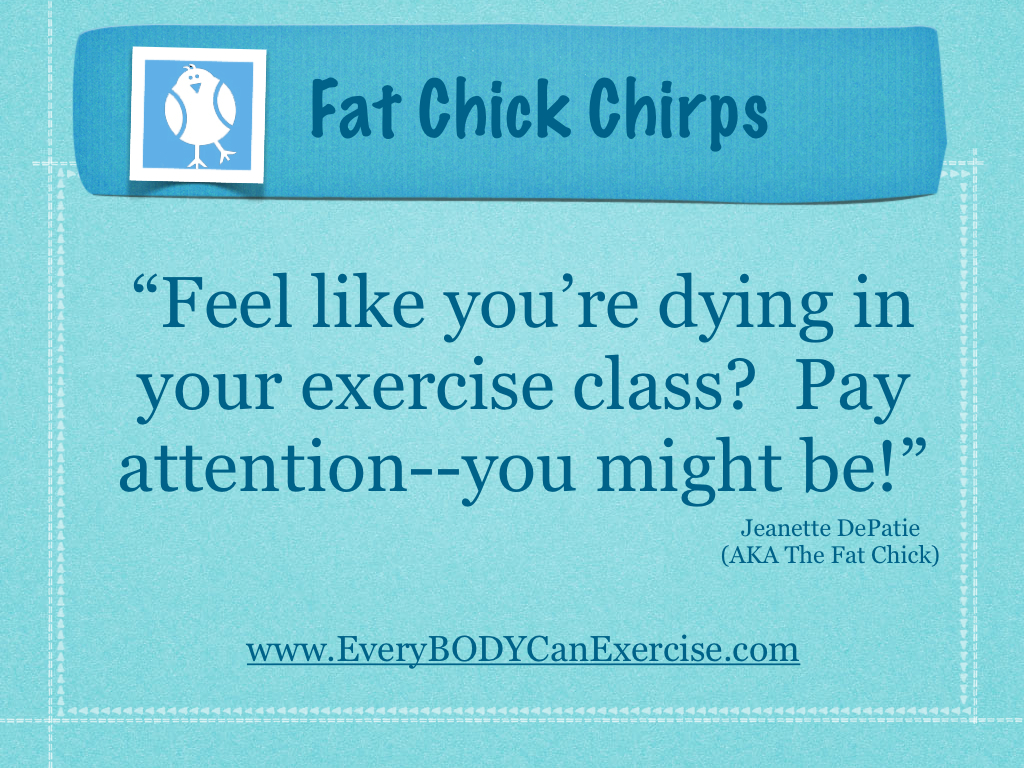
My dear friend Ragen Chastain mentioned on Facebook that she had gone to an enjoyable Zumba class the night before, but was dismayed the next day when she checked out the Zumba studio’s facebook page.  Apparently they posted an image stating: “Are You Feeling Dizzy, Sweating, Tired, Breathless? …  Good, Great Workout!!!”  I’ve posted my modified version below:

Not even going to take a chance this will get reposted without a little alteration on my part...

Not even going to take a chance this will get reposted without a little alteration on my part…

Okay, so let’s get started on how wrong this is.  Not a little bit wrong.  Not even a medium amount of wrong.  A Carl Sagan, galaxy-filled COSMOS of wrong.  This is not inspiring.  This is not cool.  This is irresponsible and dangerous.

This sign to me represents a culture where we learn to ignore the signals our bodies send as we work out.  This is about a culture of masochism, where the more pain and agony you endure during a workout, the closer you bring your body to the edge of absolute destruction during a workout, the better.  And as an exercise teacher this makes me absolutely crazy.  Because, the messages you receive from your body are the most important line of defense, the most important tool you could possibly use to keep yourself safe as you work out.

I don’t want to scare you.  Most people work out safely most of the time.  But there ARE risks associated with exercise.  If you have an underlying heart condition,  you are more likely to face a heart attack while working out than you are in your bed.  If you have issues with low blood sugar, they are more likely to surface when you are strenuously exercising.  If you are at risk for stroke, this is more likely to be an issue when you are taking an exercise class than when you are reading a book.  Again, the vast majority of the time, the vast majority of people exercise safely.  But when things do go wrong, they are often preceded by warning signs like excess sweating and severe exhaustion and shortness of breath and dizziness.  These are not indicators of a great workout.  These are indicators of a problem.  Exercisers ignore these symptoms at their own peril.

fatchickchirps.002-002As a fitness instructor, I remind my students over and over and over again that they must learn to listen to their own bodies.  I do everything I can to watch for visible warning signs and symptoms among my students.  But the first and most important line of defense is for them to recognize warning signs in themselves.  They will probably feel dizzy long before I sense that they look dizzy.  Therefore, it’s my job to create an environment where they feel safe caring for themselves.  Every time a new person comes to my class we have a ritual.  I ask my long standing students to help me.  I shout out, “What happens if you get the choreography wrong?”  My students reply, “Nothing!  It doesn’t matter!”  I shout out, “What if it hurts when I do this?”  They answer, “Stop doing it!”  I ask, “Who’s class is this?”  My students answer, “MY Class!”

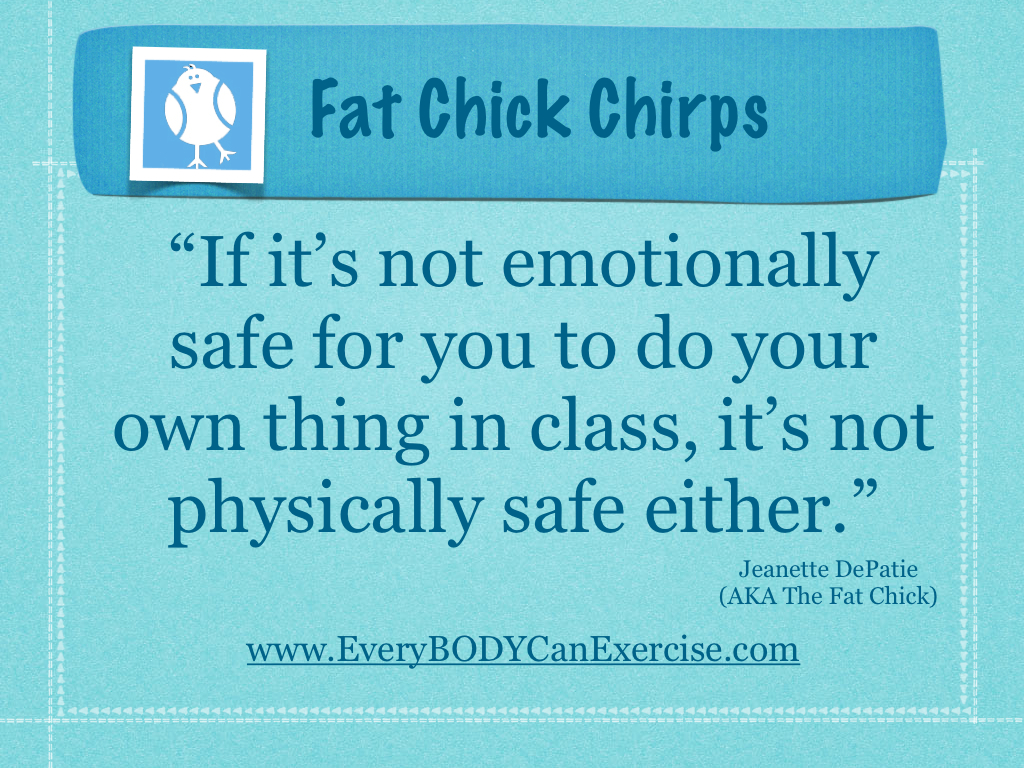
I then remind the students that it is okay for them to modify any move that isn’t working for them and to ask for help if they need it.  I give them a “safety move” like gently marching in place they should feel free to do when they get stuck.  And I remind them that they can feel free to use any of the sturdy chairs located throughout the room to do a movement or even just rest in a chair whenever they feel they need to.  I work VERY hard to create an exercise space where my students feel emotionally safe doing whatever they need to do to take care of themselves.

fatchickchirps.004-002Although creating this emotionally safe space helps my students feel good about themselves, I don’t do it for that reason alone.  I do it to keep them physically safe as well.  A class culture based on “no pain no gain”, where students are discouraged to tough it out and not take care of themselves is risky and can be downright dangerous.  Teaching students to ignore the messages their bodies are sending is the absolute LAST thing we should do.

fatchickchirps.003-002I want students in my class to look different from one another.  A class where students are modifying moves and resting from time to time and approaching the movement in different ways is good and healthy.  It means the class is challenging enough for the more advanced students to get something out of it while being a safe place for less advanced students to increase strength, stamina and agility–gently and gradually.  It means everybody is working at their own pace and having a good time.  Which is as it should be.  When students come to me and tell me that they are in pain, that is a signal for me to make some changes to my class.  How can I teach that move differently?  How can I make sure everybody is working at their own pace?  How can I remind the students about body alignment and positioning to make them less likely to get hurt?  How can I make my class better?

As I have stated before, this is why it is often best to just watch the first time you encounter a new class.  Don’t wait until after you are in the middle of a testosterone-fueled judgement festival to determine that a class might not be for you.  Don’t put yourself in a situation where you might let embarrassment push you into hurting yourself–perhaps permanently.  Watch and learn.  If your gut tells you that this is a judgement zone that is not emotionally safe–then walk away.  If the class isn’t emotionally safe for you, it’s not safe.  Period.

We tell people that exercise should hurt and feel awful.  We tell them that listening to their own bodies is wrong and that they should push it until they puke.  We tell them that getting injured is a sign of their own weakness and that real exercisers don’t let sprains or stress fractures stop them.  THEN we wonder why half the world doesn’t exercise.

Fugeddabout it!

Find a way that your body loves to move and do that.  When it stops feeling good, and it starts to hurt, then stop.  Forever and ever, Amen.

Love,

Jeanette DePatie (AKA The Fat Chick)

Stuff That Weighs More Than Me: Russian MiG

Jeanette rocks out in a Russian Mig

Jeanette rocks out in a Russian MiG

I haven’t done one of these in a while, but I just CAN’T resist.  I am speaking at the National Association of Broadcasters Event in Las Vegas this week, and while there I got a chance to sit my rump into a genuine Russian MiG.  How cool is that!?  I spotted this beautiful blue baby from across the lot and thought?  How much does that plane weigh?  I’ll bet it weighs more than me!  The lady was kind enough to take my picture.  And I got back to the convention center and did a leetle bit o’ research.  Here’s the stats:

MiG 15 bis

  • Crew: 1 or 2
  • Length: 10.08 m (33 ft 1 in)
  • Wingspan: 10.08 m (33 ft 1 in)
  • Height: 3.7 m (12 ft 2 in)
  • Wing area: 20.6 m2 (222 sq ft)
  • Airfoil: TsAGI S-10 / TsAGI SR-3
  • Empty weight: 3,630 kg (8,003 lb)
  • Gross weight: 5,000 kg (11,023 lb)
  • Max takeoff weight: 6,105 kg (13,459 lb)

And even though the cockpit was teeny tiny, any way you measure it–full, empty or at maximum takeoff weight, this Russian MiG weighs more than me.

mig2Love,

Jeanette DePatie AKA The Fat Chick

Tutus, Wonder Women and Haters

Look at that fabulous picture up there.  Does it make you smile?  Think it’s a story about motivation and joy and taking back your own power?

Sorry.  It’s a story about a “self help” magazine asking a woman if they could use her photo in their magazine and then pulling a total hater move and making fun of her in the captions.

Apparently Self magazine contacted San Diego runner Monika Allen seeking permission to use her photo in the April issue of the magazine.  Monika said yes, and was understandably excited to see her picture in the magazine.  The  online version of the magazine is already out.  And she’s excited all right, but not in a good way.

The  photo appeared in a section of the magazine called the BS Meter.  Next to the photo was this copy:

“A racing tutu epidemic has struck New York’s Central Park, and it’s all because people think these froufrou skirts make you run faster.  Now if you told us they made people run from you faster maybe we would believe it.”

Cue rimshot.  Slow hand clap.  You see what they did there?  Run from you faster.  Makes you wonder why magazine circulation numbers are crashing, right?

Now I’m sure the writer from Self was feeling pretty proud for their little moment, except maybe there’s a little research this writer failed to do.  Like the research that indicated this was Monika’s first run since being diagnosed with brain cancer.  And she was wearing this costume to help her feel motivated to keep running while she was undergoing chemotherapy.  And she makes and sells the skirts to raise money for Girls on the Run, a charity that sponsors exercise and confidence-building programs for young girls.

Whoops.

Not surprisingly the backlash online has been sort of epic.  This is what we in the biz refer to as a public relations nightmare of epic proportions.  This is a “hey kid, you’re fired” kind of maneuver.  Monika sent an email to Self saying how upset she was for the way the picture was used.  And she took to traditional and social media to tell the world how upset she was as well.

Since the story originally aired and went viral, the Editor in Chief of Self magazine “apologized” on her twitter account and sent an email apology to the local news station with this little gem:

“in our attempt to be humorous, we were inadvertently insensitive.”

“I have sincerely apologized both directly to Monika and her supporters online. At SELF we support women such as Monika; she is an inspiration and embodies the qualities we admire. We have donated to her charity and would like to cover her good work in a future issue,” the statement reads. “We wish her all the best in her road to good health.”

Let’s deconstruct, shall we?  “We thought we were being funny but we didn’t know that she would have a disease that people don’t think is funny.  Had we known that this woman had the “Big C” we would have written a tear-jerker style exploitative piece instead of a snark piece.  I mean come on!  How were we supposed to know she had cancer.  If we had known, that would have meant we were overtly insensitive, but since we didn’t know, we were inadvertently sensitive.  We have sincerely apologized in public because the public is mad and it hurts when people write mean things online.  (Although when people are mad they do comment more and our engagement numbers are up, but you can’t have everything.)  At our publication we support women like Monika when it suits us and humiliate women like Monika when we feel like it.  We have donated to her charity because hey money makes everything better and we’re kinda terrified that we will get sued.  We’d like to cover her in a future issue because usually promising “exposure” to people gets them to accept just about anything.  We wish her all the best in her recovery, because frankly, if this broad kicks the bucket, a few of us are going back to copy editing at Pennysaver.”

Speaking of being sued, please note that the above paragraph is not actually quoted from anybody at Self magazine.  I made it up.  And if it’s insensitive, I did it very much on purpose.

I wish Monika the best.  I think she is frankly going to sell a LOT more tutus after this.  And I think she is a woman we can all admire.  But I think this is an indicator.  It is really, really bad out there.  When a newsstand publication thinks that they can get permission to use a photo depicting a conventionally beautiful woman and shame her in front of the world, it’s pretty bad out there.  And for those of us who don’t meet the conventional standards of beauty, it’s a field day.  If you are a fat, gorgeous, tattooed woman who dares to post a picture of yourself in a fabulous polka dot bikini, you just might find your picture used without your permission to sell diet ads.  And when you go after the company, they will just make some excuse about how it’s the fault of their affiliates.  Because they feel pretty confident that they can do whatever they want to you.  Because if you are not conventionally beautiful, you are fair game.


Weak!

In fact, no one is safe from being abused online.  Nobody.  Don’t believe me?  Check out this amazing Ted Talk from the gorgeous and talented Maysoon Zayid, “I have 99 Problems…Palsy is Just One.”  When you have a minute, I encourage you to watch the whole thing.  It is well worth your time. It was especially touching to me to hear her say, at about 12 minutes in to her presentation:

“The doctor said I would never walk.  Yet here I am in front of you.  But I grew up with social media, I don’t think I would be.  I hope that together, we can create more positive images of disability in the media and in every day life. Perhaps if there were more positive images, it would foster less hate on the internet.  Or maybe not.  Maybe it still takes a village to teach our children well.”

I wonder.  I wonder how many powerful and world-changing people are being crushed under the need for some hater to get their three seconds of fame in the comments section.  I wonder how the search for snark is helping to foster the utter disregard for people’s lives and their well-being.  I wonder how many of our generation’s revolutionary leaders are smashed when their photos are misappropriated and tagged in an amusing meme.  I wonder how much more I could accomplish if I didn’t get nasty comments and hate mail every freaking day of my life.

Here’s hoping we can be part of the village that helps to lift one another out of the battle ground of the comments section and fight the good fight of making the world a better place.

Love, Jeanette DePatie (AKA The Fat Chick)

P.S. Want to join my list, get free stuff and be sure not to miss out on a single bit of the awesomeness?  Click here to join.

Want to learn to face the spring holidays with more joy and less trauma?  My dear friend and colleague Golda Poretsky is offering a HAES for the Holidays course just for spring.  I am an affiliate, so if you join her class, you can support me at the same time.  Win, win WIN!

 

The Red Handle, The Hot Button and Other Hair Triggers

hotbutton_intro

Recently I came across this article about Chris Christie and pulling the “red handle”.  I remember clicking on it because I didn’t know what the “red handle” was.  As I read the article, I immediately understood, in a very visceral way about the red handle and connected it to a number of recent conversations I have had with friends, family and coaching clients.

The article describes the “red handle” this way:

A lot of people have a red handle installed deep in their person, where if somebody yanks on it, it hurts.  For some people, it’s some terrible mistake they regret, and for some people, it’s something they’re always trying to get better at that hasn’t worked, or a relationship they can’t repair, or a weakness that makes them self-conscious, or a memory that’s sort of awful. I’m not any better or worse off than anybody else in having something like this in my nature/history; the only difference between mine and anybody else’s is that mine is on the outside.

I get the concept of the red handle.  Oh yes.  In my life, I always referred to it as my hot button, but I understand the idea.  The notion that, regardless of how well somebody does or doesn’t know you, they may freely assume that there is this one thing about you that is “up for grabs”.  They see a target at which they can aim.  And regardless of whether or not this is a deeply sensitive subject for you, they feel a sense of glee at being able to push your hot button or pull your red handle.

In a society that constantly hounds, harasses, embarrasses, traumatizes, cajoles and bullies people who don’t conform to an extremely narrow vision of acceptably attractive, it’s not hard to imagine body size as the red handle or hot button for many, many people.  I’m sure that’s what was behind the “attack at the Mexican restaurant” I told you about, or the many, many hateful email messages and comments I filter out of my blog, YouTube channel, website, and facebook profiles on a daily basis.  Because people are pretty sure this is my hot button/red handle.  And even though I’ve become much tougher and it doesn’t affect me nearly as much as it once did, for much of my life their guess about my hot button, my red handle would have been pretty much true.

And that sucks.  Because most of us have the ability to choose when we share our hot button with other people.  Feel insecure about your education level?  You don’t necessarily have a sign on you that says ,”I flunked calculus” that everybody in the world, including complete strangers can see.  People actually need to get to know you, get to know a little bit about you before they discover that hot button.  Your “I have abandonment issues” might not become apparent to even your closest friends or lover until your relationship deepens and becomes more meaningful.  I have often reflected on the power inherent in exposing our hot buttons, our red handles, our soft underbellies to those who love us the most.  The power that knowledge gives our loved ones to strengthen or destroy us.  To build us up and gird our loins or to wound us deeply and permanently.

But fat people don’t always get this chance.  Many of us have been bullied our entire lives about the size of our bodies and for many of us this is our hot button/red handle/soft underbelly issue.  And that means that complete strangers, can yell at us across a crowded room and wound us deeply and even permanently without having to know anything about us or even give it a second thought.

Add to this, the notion that lots and lots of people still suffer under the delusion that wounding us this way will somehow help us.  That it will shame us into “doing something about our bodies” as if we didn’t have piles and piles of proof that shaming people does not make them healthier, happier or thinner.  And what you get is fat marathoners getting eggs thrown at them, cowardly people offering unsolicited advice before they scoot off subway trains, and a whole lot of nasty aimed at our soft underbellies from people we don’t even know.

I can say that this is no longer a primary hot button or red handle for me.  And I’m not super eager to tell everybody in the world what the newer versions of those hot buttons are.  I think I’ll ask you to know me a little better before I tell you–or at least buy me a drink first.  I feel very privileged to have come to the point in my life that somebody calling me a fat cow is more likely to leave me annoyed, angry or even amused than devastated.

But it has made me more dedicated than ever to work with my amazing colleagues like Ragen Chastain and Golda Poretsky to help fat folks understand that they do not deserve to have their hot buttons pushed and their red levers pulled–and to help the world at large to understand that pushing this hot button, that pulling this red lever without permission in a complete stranger or even a friend is a form of psychological rape.   It is not justified under any circumstances, and it is never, ever okay.

Love,

Jeanette DePatie AKA The Fat Chick

P.S. Want to join my list, get free stuff and be sure not to miss out on a single bit of the awesomeness?  Click here to join.

Want to learn to face the spring holidays with more joy and less trauma?  My dear friend and colleague Golda Poretsky is offering a HAES for the Holidays course just for spring.  I am an affiliate, so if you join her class, you can support me at the same time.  Win, win WIN!